
Best LLM for AI Agent Workflows: 2026 Cost/Latency Comparison
Which LLM should power your agent? A 2026 cost and task-class breakdown of Claude Opus 4.8, GPT-5.2, Gemini 3.1 Pro, and DeepSeek V3.
TL;DR: For agent workflows in 2026, GPT-5.2 and Claude Opus 4.8 lead complex tool-calling, Gemini 3.1 Pro covers web-grounded and multi-modal tasks, and DeepSeek V3 wins high-volume, lower-stakes loops on price.
Picking an agent's reasoning engine on list price alone is a mistake: a tool-calling loop with many round trips can burn far more tokens per completed task than a single chat reply, so the per-token "cheapest" model is not always the cheapest per task. This roundup splits four models by the agent task class they actually fit, using each vendor's current published pricing rather than a stale 2025 snapshot - it's a companion to AL's LLM coding benchmark breakdown for coding-specific picks.
How was this list picked?
Included: models with a documented tool-calling API, at least 200K token context, and current 2026 published pricing. Excluded: models without a public per-token price (enterprise-only quotes) and anything retired or superseded by a same-family successor. Four models clear the bar for a 2026 agent-workflow comparison.
How do these four LLMs compare on price and context?
| Model | Input $/MTok | Output $/MTok | Context | Best for |
|---|---|---|---|---|
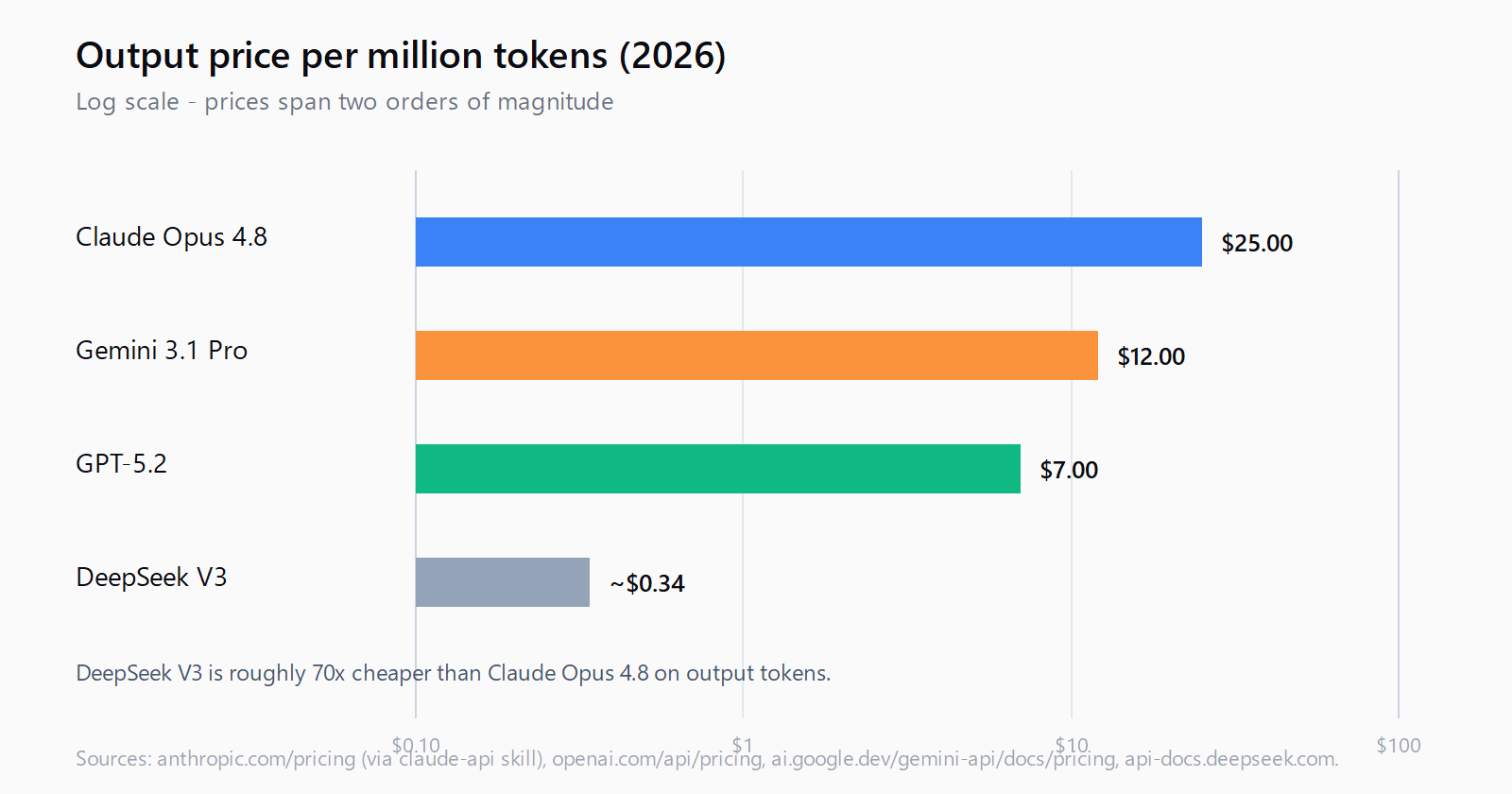
| Claude Opus 4.8 | $5.00 | $25.00 | 1M | Long-horizon autonomous agent runs |
| GPT-5.2 | $0.875 | $7.00 | 400K | High-volume tool-calling orchestration |
| Gemini 3.1 Pro | $2.00 | $12.00 | 1M (2x above 200K) | Web-grounded and multi-modal agent tasks |
| DeepSeek V3 | ~$0.23 | ~$0.34 | 64K-128K (host-dependent) | High-volume, lower-stakes tool-calling |
1. Why is Claude Opus 4.8 best for long-horizon autonomous agent runs?
Claude Opus 4.8 is Anthropic's current Opus-tier flagship: a 1M token context window at standard pricing (no long-context premium) and up to 128K output tokens. It is built for state-of-the-art long-horizon agentic execution - overnight coding runs, multi-step research, and tasks that need to hold context and self-correct across dozens of tool calls without human correction.
Pricing: $5.00 input / $25.00 output per million tokens. Strengths: the highest coherence over long tool-calling sessions in this list, and adaptive effort control (low through max) to tune cost per task. Watch out for: at $25/MTok output, a chatty agent that narrates every step burns budget fast - tune effort down or add a narration-discipline instruction for cost-sensitive loops.
2. Why is GPT-5.2 best for high-volume tool-calling orchestration?
GPT-5.2 undercuts every other frontier model in this list on price while still handling structured tool-calling and orchestration well, per OpenAI's published pricing. Its 400K context window is smaller than Opus 4.8's or Gemini 3.1 Pro's 1M ceiling, which matters for agents that need to hold very large tool-result histories in a single call.
Pricing: $0.875 input / $7.00 output per million tokens - roughly 6x cheaper than Opus 4.8 on input and 3.5x cheaper on output. Strengths: the best price-to-capability ratio for agents that make many tool calls per task. Watch out for: the smaller context ceiling means very long agent transcripts need compaction sooner than on Opus 4.8 or Gemini 3.1 Pro.
3. Why is Gemini 3.1 Pro best for web-grounded and multi-modal agent tasks?
Gemini 3.1 Pro prices at $2.00 input / $12.00 output per million tokens for requests under 200K context, rising to $4.00 / $18.00 above that threshold, per Google's pricing page. It sits between GPT-5.2 and Opus 4.8 on price and leans on Google's own web-grounding and multi-modal strengths for agents that browse, read screenshots, or process mixed media as part of the loop.
Pricing: tiered by context length - budget for the 2x jump if agent transcripts regularly exceed 200K tokens. Strengths: strong web navigation and multi-modal grounding baked into the same price tier as general tool-calling. Watch out for: the context-length pricing cliff means a single long-running agent session can double in cost mid-task without a code change - track cumulative context, not just per-call token counts.
4. Why is DeepSeek V3 best for high-volume, lower-stakes tool-calling?
DeepSeek V3 is the open-weight budget option: roughly $0.23 input / $0.34 output per million tokens on hosted APIs, according to DeepSeek's own pricing docs - about 20x cheaper than Opus 4.8 per token and around 4x cheaper than GPT-5.2. Cache hits price at 10% of the input rate, which compounds the savings for agents that repeat similar tool-call patterns.
Pricing: the cheapest per-token rate in this list by a wide margin. Strengths: the price point makes high-volume, lower-stakes agent loops (bulk classification, routine data extraction, simple tool-calling chains) viable at a fraction of frontier-model cost. Watch out for: weaker long-horizon coherence than Opus 4.8 on genuinely complex, many-step tasks - reserve it for loops where a wrong step is cheap to catch and retry, not for irreversible actions.
Which models almost made the list?
Claude Sonnet 4.6 ($3/$15 per MTok) and Claude Haiku 4.5 ($1/$5 per MTok) are Anthropic's mid-tier and budget options respectively - both viable, but Opus 4.8 and GPT-5.2 bracket the price-to-capability curve more usefully for this comparison. Claude Fable 5, Anthropic's most capable widely-released model at $10/$50 per MTok, is intentionally excluded from the default agent-workflow pick: it costs more than Opus 4.8 and is built for the hardest long-horizon reasoning, not routine agent orchestration. Teams already running Claude Code should check AL's Claude Code pricing breakdown before assuming a subscription plan is cheaper for agent workloads.
How do you decide which LLM fits your agent workflow?
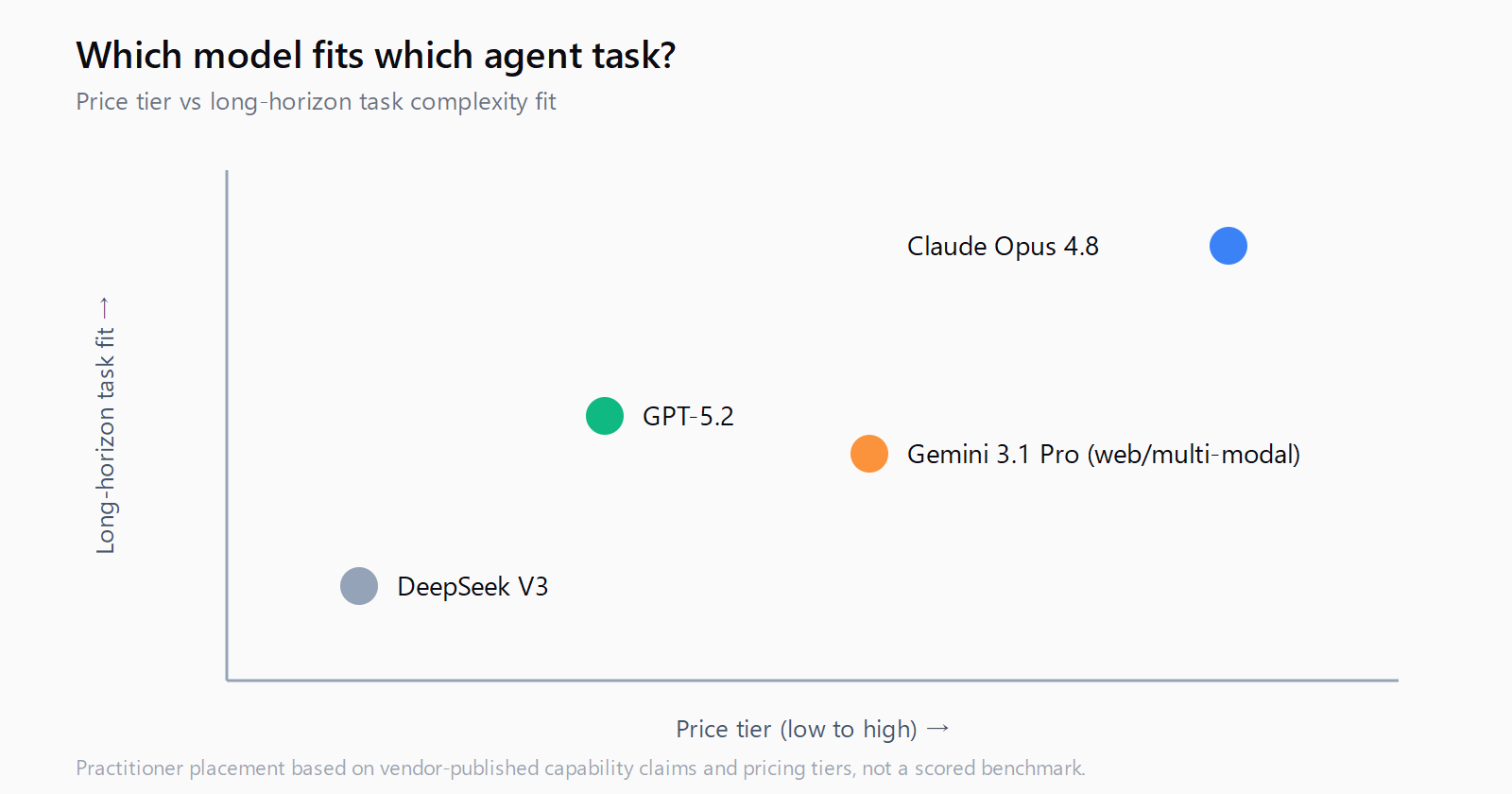
Run the task-class audit before picking a model: if the agent runs long, autonomous, many-step sessions where a wrong turn is expensive to unwind, pick Claude Opus 4.8. If the workload is high-volume tool-calling where per-task cost matters more than marginal capability, start with GPT-5.2. If the agent needs to browse the web or reason over screenshots and images as part of the loop, Gemini 3.1 Pro's pricing tier fits that mix. If the loop is high-volume and lower-stakes - and a wrong step just gets retried - DeepSeek V3's price makes it viable at a scale frontier models can't match economically. For a fuller line-item cost model, see AL's agentic workflow versus RPA cost breakdown.
FAQ
What's the cheapest LLM for high-volume tool-calling agents?
DeepSeek V3, at roughly $0.23/$0.34 per million tokens, is the cheapest option in this list capable of structured tool-calling - about 20x cheaper than Claude Opus 4.8 per token.
Does model cost scale with tokens-per-task or just the per-token rate?
Both. A tool-calling loop with many round trips can consume far more tokens per completed task than a single chat turn, so total task cost depends on tokens-per-task times the per-token rate - not the rate alone.
Is DeepSeek V3 good enough for production agents?
For high-volume, lower-stakes loops where a wrong step is cheap to catch and retry, yes. For long-horizon, many-step tasks where errors compound, Claude Opus 4.8 has stronger coherence.
How does Claude's pricing compare across tiers?
Claude Haiku 4.5 is $1/$5 per MTok, Sonnet 4.6 is $3/$15, and Opus 4.8 is $5/$25 - each tier roughly doubling in price up the ladder, with Claude Fable 5 sitting above all three at $10/$50 for the hardest reasoning work.
When does a cheaper model start winning on total cost?
When the task doesn't need frontier-level long-horizon coherence - routine extraction, classification, or short tool-calling chains - a cheaper model's lower per-token rate usually wins outright, since it isn't offset by materially more tokens or retries per task.