
Best AI Agent Framework for Node.js Developers in 2026
Compare Node.js agent frameworks by features, licences and Node requirements, with current AI SDK and LangChain agent-loop guidance.
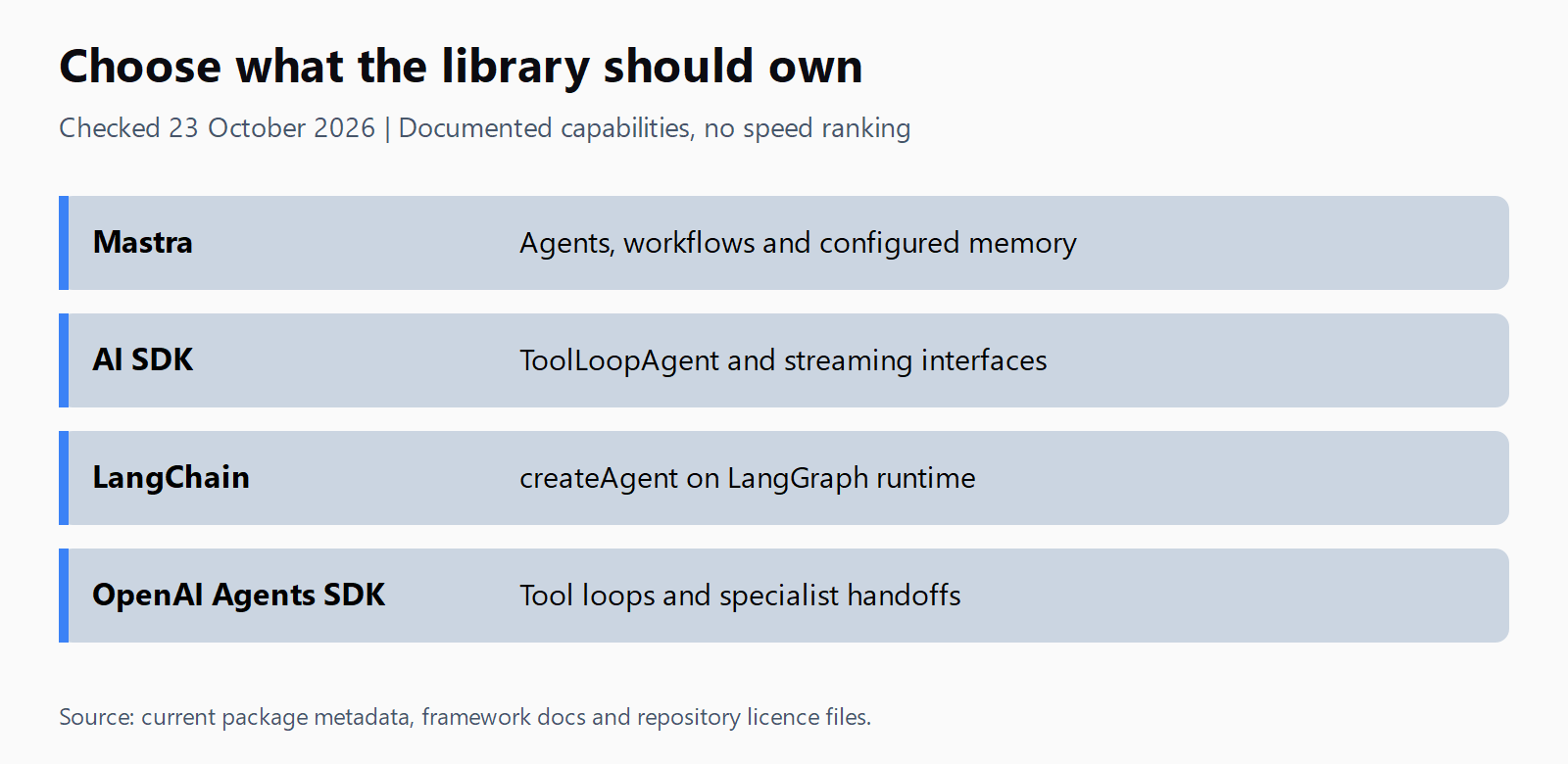
TL;DR: Pick Mastra for an integrated TypeScript agent backend, AI SDK for agent loops and streaming interfaces, LangChain for configurable agents, and OpenAI Agents SDK for specialist handoffs.
Checked 23 October 2026. The useful comparison is what each library owns and what your application must still configure. Current AI SDK and LangChain both run tool-using agent loops; neither requires another framework merely to make repeated tool calls.
How was this list picked?
The four original choices remain because they offer documented JavaScript or TypeScript agent APIs. This refresh checks npm's latest release tag, runtime requirements, source licences and current docs. A version number below 1.0 does not automatically disqualify a maintained vendor SDK, and a major version above 1.0 does not prove production suitability.
These are recommendations by use case, without a performance benchmark. Evaluate your exact provider, tools and deployment target. Python teams can use the companion Python agent framework comparison; similar concepts do not guarantee matching APIs across languages.
How do these four Node.js AI agent frameworks compare?
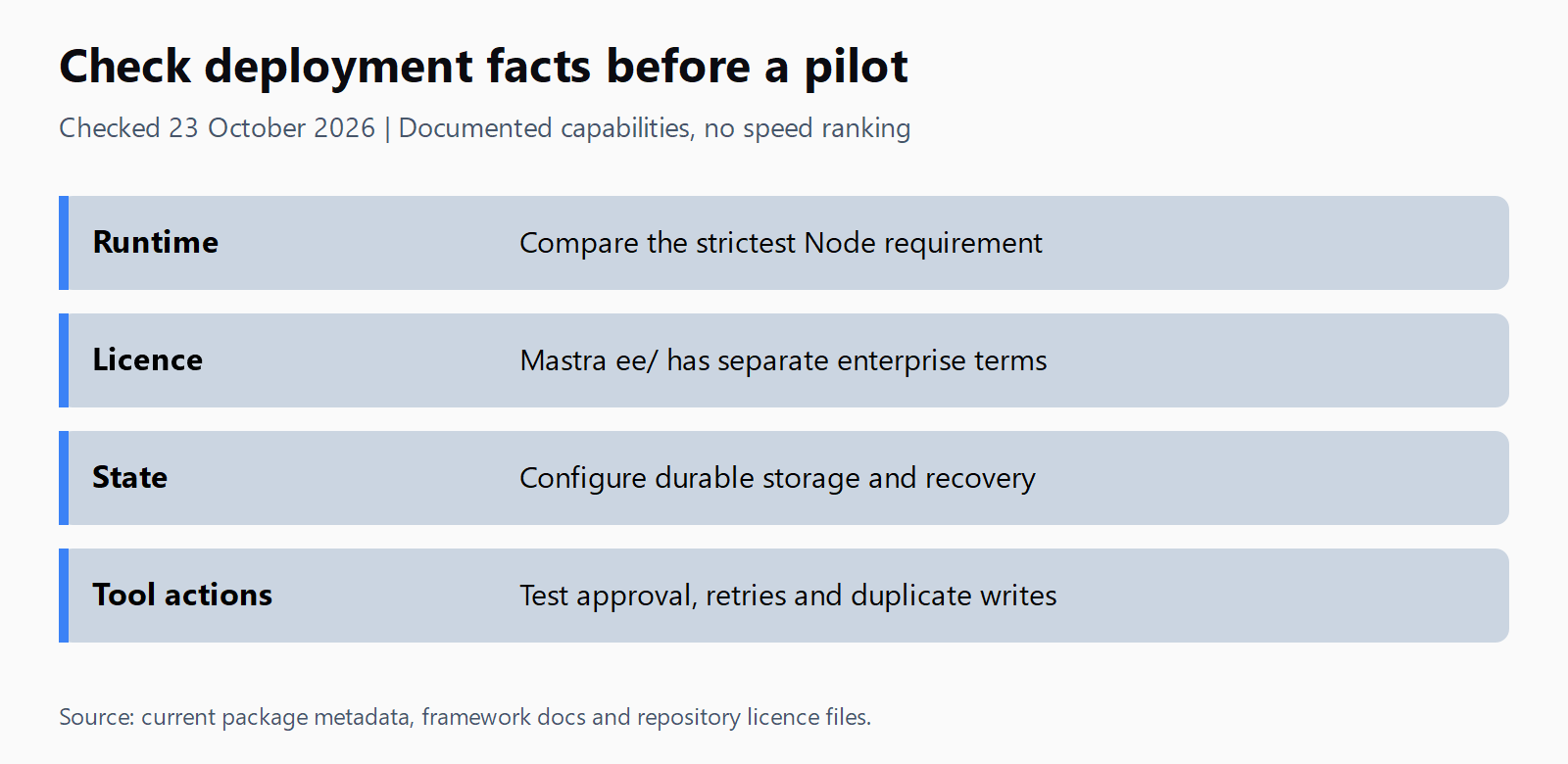
Versions, licences and Node requirements checked October 2026. Package engine ranges below are minimum declarations, not a recommendation to deploy an old Node release. Check the whole dependency tree and choose a supported runtime that satisfies its strictest requirement.
| Package | npm latest | Node requirement | Core licence |
|---|---|---|---|
@mastra/core | 1.79.0 | >=22.13.0 | Apache-2.0 outside ee/ |
ai | 7.0.150 | >=22 | Apache-2.0 |
langchain | 1.5.19 | >=20 | MIT |
@langchain/langgraph | 1.5.2 | >=18 | MIT |
@openai/agents | 0.21.0 | 22+ documented in README | MIT |
Mastra's repository licence applies Apache-2.0 outside separately licensed ee/ directories; its Enterprise Edition licence governs those enterprise portions. An npm package's short licence field does not describe every file in a repository. Model APIs, storage and managed services also have separate costs and terms.
| Library | Documented agent feature | Pick it if | You still own |
|---|---|---|---|
| Mastra | Agents, workflows, memory, Studio and eval tooling | You want one TypeScript framework around the backend | Storage configuration, auth and relevant EE entitlement |
| AI SDK | ToolLoopAgent, streaming UI primitives and HarnessAgent | Agent behaviour should fit an existing app and UI | Persistent history and application recovery design |
| LangChain | createAgent on LangGraph's runtime | Provider/tool integrations and middleware fit the service | State persistence, permissions and custom process rules |
| OpenAI Agents SDK | Tool loop, handoffs, guardrails and tracing | Specialists should transfer conversation ownership | Deployment, storage and approval decisions |
1. When should you pick Mastra for an agent backend?
Pick Mastra when agents, workflow orchestration and debugging should share a TypeScript framework. Its Mastra documentation presents the framework's agent and application tooling. The workflow guide describes explicit steps, branching and suspension/resumption, which suit processes where application logic must control the order of work.
Memory is configurable infrastructure. The memory guide requires the memory package and a storage provider for persisted history. Decide where conversations live and how users are separated before treating a local demo as a service. Studio is useful for inspection, but it does not replace authentication or access controls.
The current @mastra/core package requires Node 22.13.0 or later. Check that your host and build image meet it. Compare setup and debugging on a representative task before committing to the framework; a feature list cannot measure the development work for your application.
2. When should you pick AI SDK for an existing app?
Pick AI SDK when a tool-using agent should work with your application's model calls and streaming interface. Its agent documentation recommends ToolLoopAgent for repeated model/tool steps, context management and stopping conditions. The old claim that AI SDK cannot run a multi-step agent is incorrect.
Current harness documentation also documents HarnessAgent, which adapts an established agent harness into SDK-compatible streams. A harness differs from a model provider: it owns more of the execution loop. Choose the abstraction that matches whether your application or an existing harness should drive the task.
An agent loop alone does not settle persistence, worker restart or tenant isolation. Define where history is stored and how an interrupted job is recovered. AI SDK's model/provider interface and UI components can be useful without adopting a second agent backend.
3. When should you pick LangChain and LangGraph in TypeScript?
Pick LangChain when its tool integrations and configurable agent interface fit the service. The JavaScript overview uses createAgent and states that LangChain agents run on LangGraph. Adding a custom graph is therefore a choice about owning process structure, rather than a prerequisite for looping or saved state.
Use explicit LangGraph nodes and edges when mandatory business stages or custom state transitions belong in application logic. The LangChain versus LangGraph decision guide explains that control-level choice. Compare actual TypeScript interfaces with Python documentation before planning a port; blanket feature parity is not a reliable contract.
4. When should you pick the OpenAI Agents SDK?
Pick the OpenAI Agents SDK when tools and specialist handoffs express the workflow without a custom state graph. Official OpenAI documentation describes an SDK loop running in your application, with your server owning tools, deployment, storage and approvals. Traces help inspect what happened; they do not prove a tool's business result is correct.
The provider guide directs mixed-provider workloads to language-specific adapters, while noting that some features depend on the Responses path. Verify the required features on the selected provider. The JS README documents Node 22 or later even though the umbrella package's npm metadata does not declare an engine range.
Which frameworks almost made the list?
LlamaIndex.TS is another candidate when retrieval drives the design; use its TypeScript docs to check the current agent and data APIs. CopilotKit's documentation covers agent-facing application interfaces and connections. These tools can occupy different layers, so choose them for a concrete responsibility rather than excluding them through a universal ranking.
How do you decide between these four?
Build one small workflow on two candidates with the same provider and tools. Include a successful lookup, missing data and rejected approval. Then restart after a completed external write and inspect whether recovery repeats it. Measure completed outcomes and cost, not the length of a demo snippet.
- Choose Mastra when integrated backend workflows and configurable memory fit the project.
- Choose AI SDK when the agent loop and streaming interface belong in the existing app.
- Choose LangChain when its agent API fits, adding explicit LangGraph routing for custom process structure.
- Choose OpenAI Agents SDK when specialist handoffs fit, then verify storage, provider support and approvals.
FAQ
Is the Vercel AI SDK a full agent framework?
It provides ToolLoopAgent and agent workflow patterns, so it can run multi-step agents directly. Decide separately how the application will persist history and recover jobs; another framework is optional.
Can you use Vercel AI SDK and Mastra together?
Yes: Mastra documents an AI SDK UI integration. Use it when Mastra should own backend agent execution and the SDK UI should render the conversation, with one clear owner for each responsibility.
Does LangChain.js have feature parity with Python LangChain?
Check the specific TypeScript API and integration rather than assuming parity. Current JavaScript createAgent uses LangGraph, but package versions and interfaces differ across languages.
Is there an OpenAI Agents SDK for Node.js?
Yes, published as @openai/agents with tools, handoffs and tracing. Follow the JavaScript runtime and provider guidance rather than copying a Python example unchanged.
Which framework is fastest to prototype a tool-calling agent in TypeScript?
No comparable speed benchmark was run for this guide. Start with the API that fits the task and compare actual implementation work, failure handling and completed outcomes.