
UiPath vs Power Automate for Enterprise Scale in 2026
Compare enterprise RPA licences, unattended capacity and governance, with current CoE Starter Kit guidance and a practical procurement checklist.
TL;DR: Shortlist UiPath for a central RPA team or Power Automate for an established Power Platform estate, then compare tested reliability, unattended capacity and governance ownership.
Checked 26 October 2026. Microsoft now says the CoE Starter Kit is no longer actively maintained and recommends the Power Platform admin center. Enterprise buyers should also compare user licences, unattended capacity and hosting separately. A user subscription is not a per-bot quote.
This guide covers enterprise procurement and controls. For a smaller team's buying decision, read the UiPath versus Power Automate SMB comparison. Its budget and setup questions complement this guide; neither article establishes a universal fleet-size cutoff.
How do UiPath and Power Automate compare at 100+ bots?
At this scale, count simultaneous sessions, process owners and environments before counting automation definitions. One hundred workflows that run sequentially have different capacity needs from one hundred desktop jobs that must finish together.
Comparison and prices checked October 2026. These are procurement starting points, not a measured performance ranking.
| Enterprise question | UiPath | Power Automate |
|---|---|---|
| Best fit to investigate | Dedicated RPA team with central orchestration and demanding UI work | Teams already operating Power Platform governance and Microsoft workflows |
| What is being licensed? | Quoted platform, user, robot and consumption entitlements | Premium users, Process capacity or Hosted Process capacity |
| Governance starting point | Orchestrator roles, folders and audit; confirm plan boundaries | Power Platform admin center, data policies and eligible Managed Environments |
| Desktop reliability | Validate selectors, recovery and virtual-desktop requirements | Validate selectors, recovery and virtual-desktop agent requirements |
| People and operations | Assign release, credentials, exception and audit owners | Assign the same responsibilities; existing admins still need capacity |
What do enterprise licences cost in October 2026?
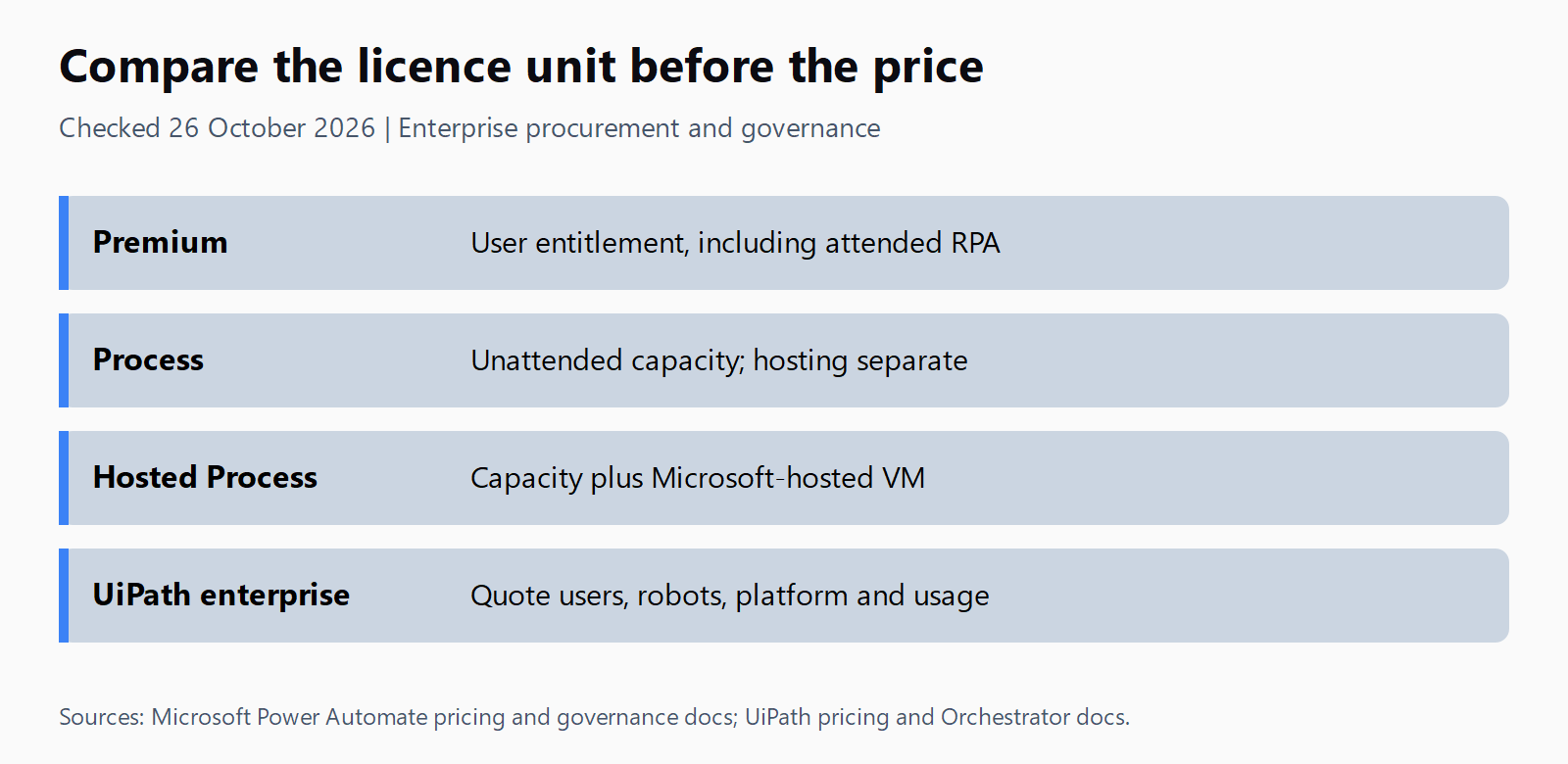
The Microsoft Ireland price list provides these EUR monthly equivalents, paid yearly, excluding VAT. Contract and regional prices can differ.
| Plan | List price | Compare this unit |
|---|---|---|
| Power Automate Premium | €13.00/user/month | Named user, including attended RPA |
| Power Automate Process | €130.00/bot/month | Unattended capacity; hosting separate |
| Power Automate Hosted Process | €186.30/bot/month | Capacity with a Microsoft-hosted VM |
| UiPath enterprise deployment | Custom quote | Price the actual platform, users, robot capacity and consumption |
UiPath's pricing page directs enterprise purchasing to sales. Its entry-level offer is not an enterprise unattended-bot quote. The previous comparison's fixed UiPath per-bot figure and 2-3x multiplier are removed because they mixed unlike licence units.
For illustration, ten concurrent unattended sessions at the Microsoft list prices imply €1,300/month for Process capacity, or €1,863/month for Hosted Process. This is capacity arithmetic, not total cost of ownership. Add required user entitlements, infrastructure where applicable, support, AI consumption and operating staff before comparing quotes.
Microsoft's licence types guide distinguishes Process capacity assigned to a machine from capacity assigned to a cloud flow. Each machine-allocated Process licence enables one concurrent unattended desktop run; additional concurrent runs require capacity. The user whose connection triggers desktop flows from cloud flows also needs an eligible user licence.
Where does UiPath win at enterprise scale?
UiPath is worth piloting when a dedicated automation team wants Orchestrator to own its desktop estate. Its audit documentation describes administrative activity records and export. Confirm retention and export separately for platform audit and robot execution logs; an audit feature does not mean every business action has a permanent evidential record.
Credential handling also needs a plan check. UiPath's credential-store guide lists external stores with availability dependent on the cloud offering and licence. Confirm your vault and folder access before buying. The Orchestrator folder-context guide shows why resource scope matters in practice.
For Citrix or other difficult screens, evaluate UiPath's documented Computer Vision activities against representative applications. Power Automate also documents Citrix and RDP automation with an installed agent. Neither capability list proves which product will recover better from your application's failures.
Where does Power Automate win at enterprise scale?
Power Automate is a sensible first pilot when the organisation already administers Power Platform and most candidate workflows use its connections. Premium and Process rights can cover premium and custom connectors in their licensed context. Check the licensing FAQ for the actual users and flows; connector access is not automatically an extra fee on every paid plan.
The governance starting point has changed. Microsoft's CoE Starter Kit transition notice says the kit remains available but is no longer actively maintained. It recommends native admin-center Inventory, Usage, Monitor and Actions capabilities. Existing kit users should assess their dependencies and migration work rather than start a new programme on an assumed maintained governance package.
Managed Environments adds premium management capabilities with licensing requirements. Data policies control connector use. Administrators still have to define environment boundaries, approve access and handle incidents. These controls do not establish a zero-headcount operating model.
When should you pick neither platform?
Check whether the process can use supported APIs without desktop interaction. A small integration service may be easier to operate when the work is deterministic API calls and the team already owns the runtime. Include authentication, retries, monitoring and support in that comparison.
Do not assume a fixed share of enterprise processes belongs on either platform. UI dependence, access restrictions and business controls should determine the shortlist. Two platforms can coexist, but duplicate credential management, release processes and incident ownership also have costs.
How do you decide between UiPath and Power Automate at scale?
Run the same bounded pilot on both candidates before a fleet purchase. Include a normal transaction, a changed screen, an expired credential and a failure immediately after an external write. Record completion rate, recovery effort, peak session demand and whether retries duplicate business actions.
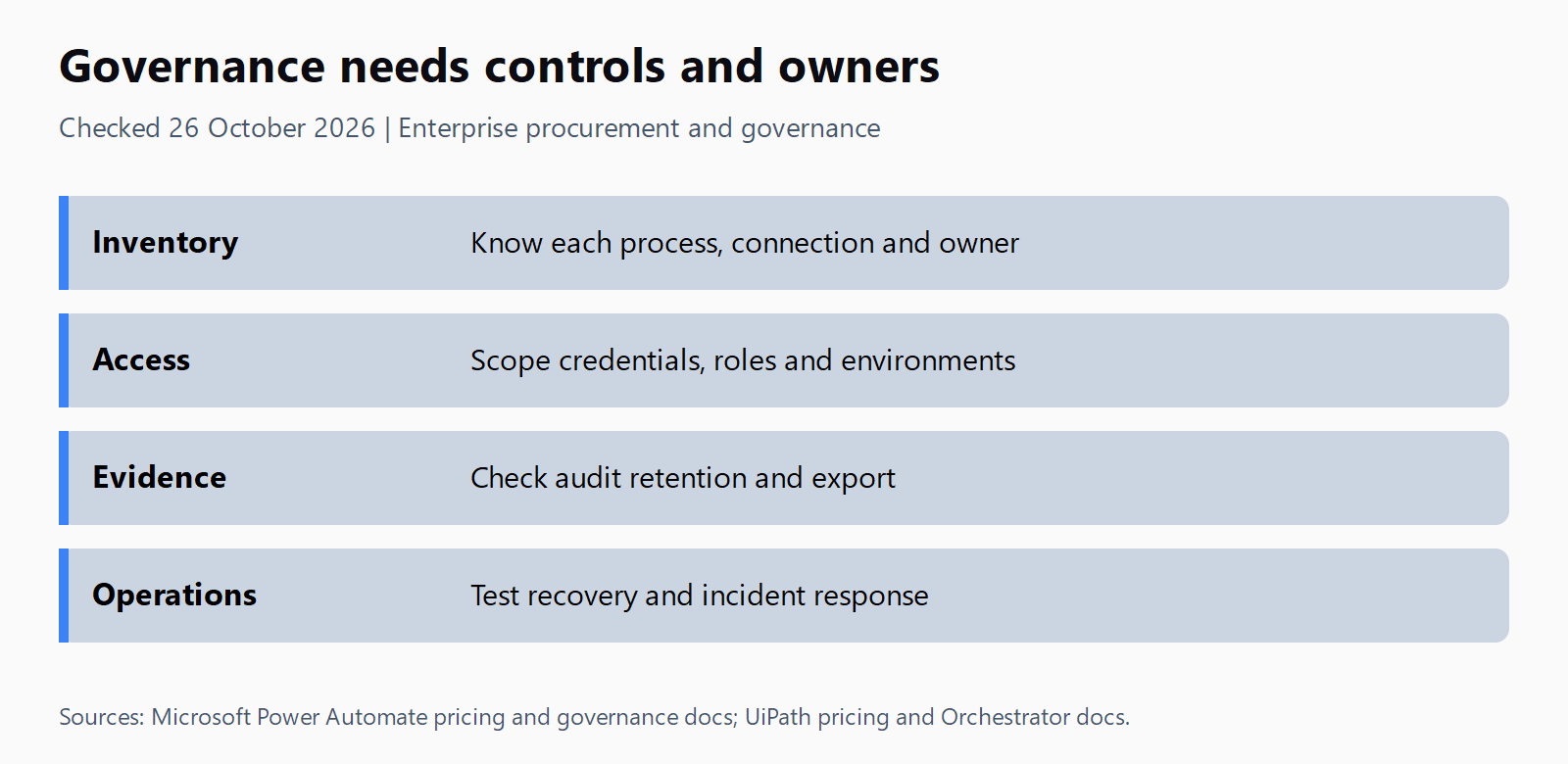
- Inventory processes, dependencies, peak concurrency and recovery deadlines.
- Require equivalent quotes for users, capacity, hosting, consumption and support.
- Test role separation, credential scope, audit export and restore procedures.
- Name the owners of releases, exceptions and out-of-hours incidents.
The better purchase is the one that meets those acceptance criteria at a supportable operating cost. This guide does not claim a measured staffing ratio, productivity multiplier or universal TCO saving.
FAQ
Can enterprises run UiPath and Power Automate together?
Yes. Allocate each process to an owner and define its handoff, credentials and recovery rules. Coexistence should solve a specific process requirement rather than follow an arbitrary bot-count threshold.
What does a UiPath Center of Excellence cost per year?
There is no verified universal staffing cost in this comparison. Budget from delivery demand, support hours, compliance work, infrastructure and the vendor quote; assign operating owners for either platform.
Does Power Automate handle unattended RPA at UiPath's scale?
It supports unattended desktop automation. Machine-allocated Process capacity covers one concurrent unattended desktop run per licence. Validate peak concurrency, service limits and recovery against the actual workload instead of inferring equivalence from total workflow count.
How does Copilot Studio change the governance story in 2026?
Agent access needs explicit governance too. Microsoft's Copilot Studio data-policy guidance describes controls over connectors and agent capabilities. Check permissions, consumption and approval behaviour separately; adding an agent does not remove existing control requirements.
Is the Power Platform CoE Starter Kit really free?
A download does not remove underlying licensing or operating work. Microsoft says the kit is no longer actively maintained and recommends Power Platform admin center capabilities. Check existing deployments and required entitlements before treating it as the basis for a new programme.