
Best AI Agent Framework for Node.js Developers in 2026
Mastra, Vercel AI SDK, LangChain.js, or the OpenAI Agents JS SDK? Here's the Node-specific ranking most 2026 roundups skip.
TL;DR: For Node.js teams in 2026, Mastra wins for a dedicated agent stack, Vercel AI SDK wins for adding AI to an existing Next.js app, and LangChain.js fits teams porting Python patterns.
Most "best AI agent framework" roundups rank tools across every language at once, which buries the Node-specific tradeoffs. The split that actually matters for a TypeScript team: whether you want a full agent framework (memory, workflows, evals) or a lean toolkit you bolt onto an app you already have. See AutomateLab's companion post on Pydantic AI wins on type safety if your stack is Python instead.
How was this list picked?
Included: actively maintained (a release or commit in the last 90 days), first-class TypeScript types, and either a documented streaming path or an explicit multi-agent orchestration story. Excluded: frameworks without a stable v1.0+ release, and generic HTTP-client wrappers with no tool-calling abstraction. Four tools clear the bar for 2026.
How do these four Node.js AI agent frameworks compare?
| Tool | Type | Best for | Multi-agent orchestration |
|---|---|---|---|
| Mastra | Full framework | Dedicated TypeScript agent backend | Yes - built-in workflows |
| Vercel AI SDK | Toolkit | Adding AI to an existing Next.js/React app | No - pair with Mastra or LangGraph.js |
| LangChain.js | Full framework | Parity with an existing Python LangChain investment | Via LangGraph.js |
| OpenAI Agents JS SDK | Lightweight SDK | OpenAI-native minimal orchestration | Yes - handoffs between agents |
1. Why is Mastra best for a dedicated production agent stack?
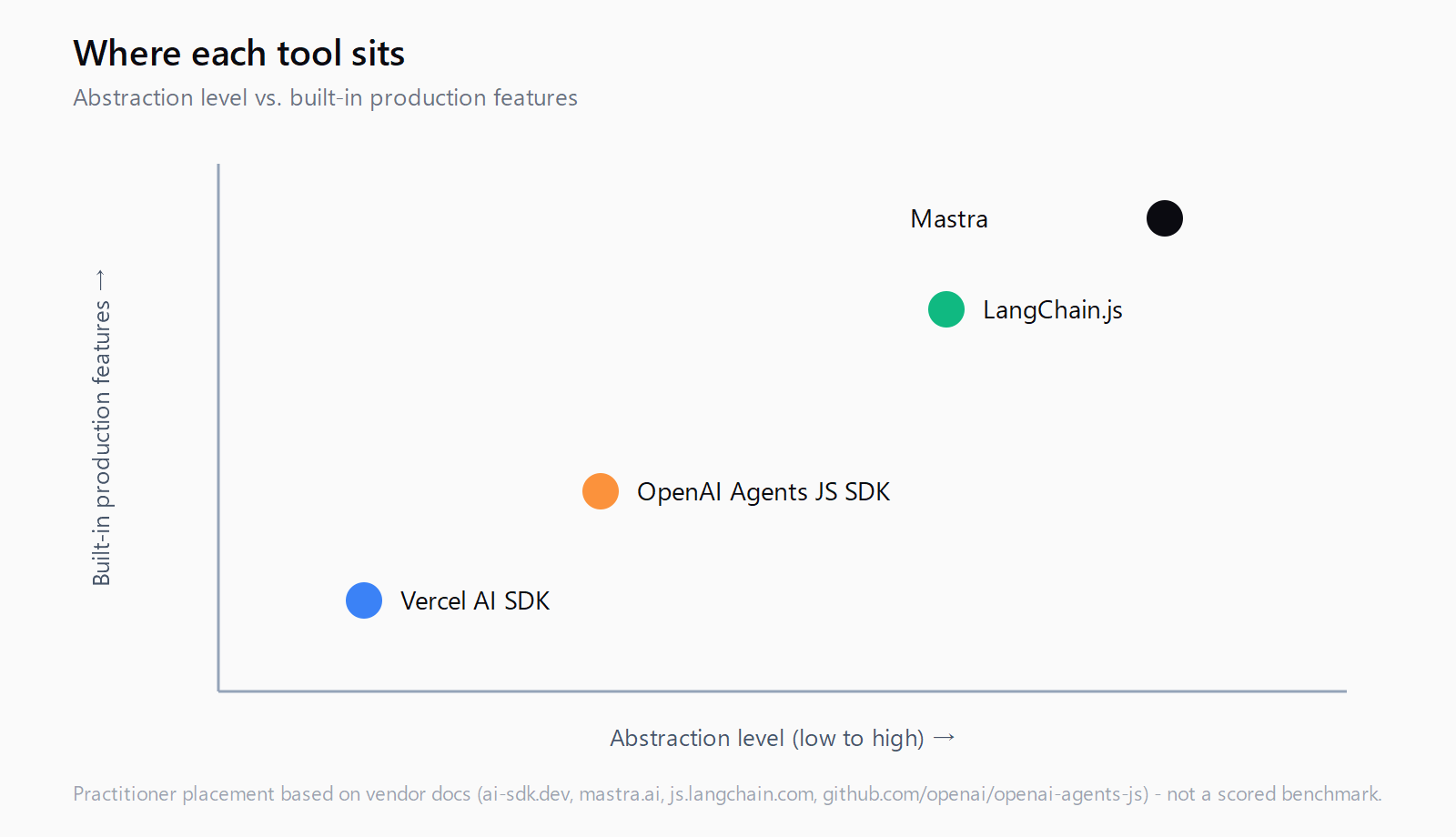
Mastra is a TypeScript-first framework built specifically for production agents: workflows, persistent memory, a built-in Studio for local debugging, evals, and RAG ship as part of the core package instead of separate libraries you assemble yourself. It targets teams whose backend and frontend are both TypeScript and who want one dependency graph instead of five.
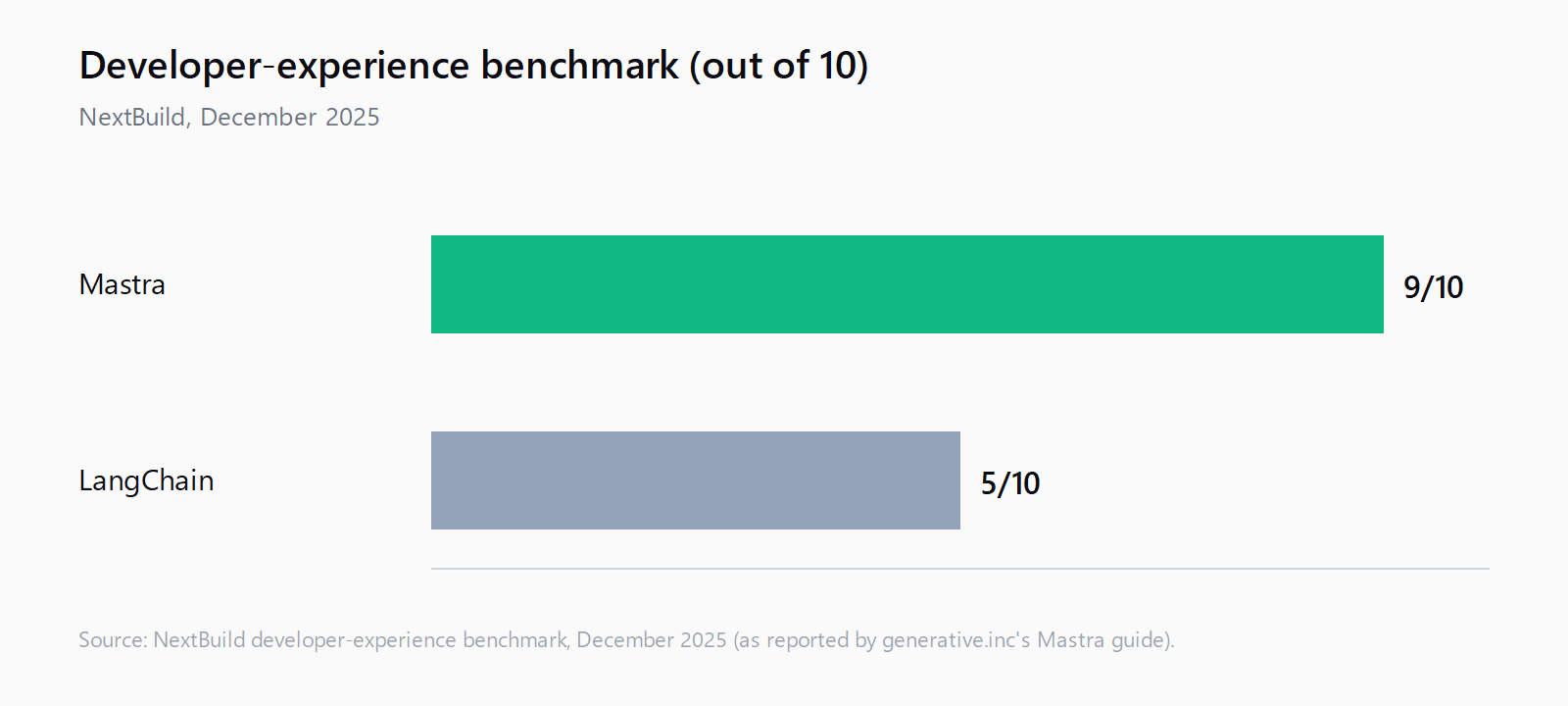
Strengths: a December 2025 NextBuild developer-experience benchmark scored Mastra 9/10 versus LangChain's 5/10, and Mastra's own docs confirm Studio ships as a local UI for inspecting agent runs without standing up separate tooling. Watch out for: the framework is younger than LangChain.js, so the plugin and integration ecosystem is smaller; teams needing a long tail of niche connectors may still hit gaps.
2. Why is Vercel AI SDK best for adding AI to an existing app?
The Vercel AI SDK is the most downloaded TypeScript AI toolkit, and for good reason: it standardizes text generation, structured output, and tool calling across 25+ model providers with almost no abstraction layer on top. Version 7.x adds "AI SDK Harnesses," a uniform API for pre-built agent harnesses like Claude Code and Codex, on top of the existing streaming-first core, per the official AI SDK docs.
Strengths: best-in-class streaming UI hooks for React/Next.js, edge-runtime support, minimal lock-in. Watch out for: it is explicitly a toolkit, not a full agent framework - no built-in memory, workflow engine, or multi-agent orchestration. Teams that need those pair it with Mastra or LangGraph.js rather than treating the SDK alone as their agent layer.
3. Why is LangChain.js best for parity with Python LangChain?
LangChain.js mirrors the Python library's component model - chains, agents, memory, retrievers, and dozens of document-loader integrations, per LangChain.js's own docs - which matters for teams that already standardized on LangChain in Python and want the same patterns on the Node side. As with the Python library, the base package is a directed acyclic graph; production teams add LangGraph.js when an agent needs to loop or hold state across turns.
Strengths: the largest TypeScript agent ecosystem by integration count, direct conceptual parity with LangChain's Python docs. Watch out for: the same DX gap practitioners report on the Python side shows up here too - more moving parts than Mastra for teams starting fresh with no prior LangChain investment.
4. Why is the OpenAI Agents JS SDK best for OpenAI-native minimal orchestration?
The OpenAI Agents JS SDK mirrors its Python sibling: a lightweight framework for multi-agent workflows with handoffs, guardrails, and built-in tracing, built on OpenAI's own APIs. It suits teams who are committed to OpenAI models and want the vendor's own opinion on agent structure rather than a third-party abstraction layer.
Strengths: minimal boilerplate for a single-agent or handoff-based multi-agent flow, official tracing out of the box. Watch out for: the ecosystem is OpenAI-first - swapping in Anthropic or Google models is possible but less first-class than in provider-agnostic toolkits like Vercel AI SDK or Mastra.
Which frameworks almost made the list?
LlamaIndex.TS almost made the list - it is a solid choice specifically for RAG-heavy Node applications, but its agent orchestration story is thinner than Mastra's or LangChain.js's outside the retrieval use case. CopilotKit didn't make the cut here because it is a UI layer for embedding agent chat into a product, not itself an agent-orchestration framework - it typically sits on top of one of the four above.
How do you decide between these four?
If you're adding an AI feature to an app you already ship, start with the Vercel AI SDK - it does less, which is the point. If you're building a dedicated agent product and your whole stack is TypeScript, pick Mastra for the built-in workflows, memory, and Studio debugging. If your team already runs LangChain in Python, LangChain.js keeps the same mental model on the Node side. If you're committed to OpenAI models and want vendor-blessed simplicity, the OpenAI Agents JS SDK needs the least code to ship a handoff-based agent.
FAQ
Is the Vercel AI SDK a full agent framework?
No - it is a toolkit for model calls, streaming, and tool calling. It has no built-in memory or workflow engine, so teams building genuine multi-step agents typically pair it with Mastra or LangGraph.js.
Can you use Vercel AI SDK and Mastra together?
Yes. A common pattern is Vercel AI SDK for the streaming chat UI and provider abstraction, with Mastra handling the underlying agent workflow, memory, and evals.
Does LangChain.js have feature parity with Python LangChain?
Largely yes for the core chain, agent, and retriever abstractions, though new features sometimes land in the Python library first before shipping to the JS port.
Is there an OpenAI Agents SDK for Node.js?
Yes - the OpenAI Agents JS SDK mirrors the Python openai-agents-python SDK, with handoffs, guardrails, and tracing built in.
Which framework is fastest to prototype a tool-calling agent in TypeScript?
The OpenAI Agents JS SDK and Vercel AI SDK both ship a working tool-calling agent in under 30 lines of code; Mastra and LangChain.js take more setup but return more production infrastructure for that cost.