
Fix LangChain Output Parsing Errors (handle_parsing_errors=True)
handle_parsing_errors=True only retries LangChain's free-text ReAct loop -- it can't fix a model that won't format output reliably. Here's what actually works.
TL;DR: handle_parsing_errors=True only retries the same free-text ReAct loop, so switch the agent to tool calling or a LangGraph create_react_agent instead of patching the parser.
"An output parsing error occurred" keeps showing up even after adding handle_parsing_errors=True to an AgentExecutor. One GitHub issue reports a pandas DataFrame agent on GPT-4 failing to parse roughly 60% of the time with the flag already set; it was closed "not planned" with no maintainer fix. The flag isn't broken - it's solving a different problem than the one causing the failure. This is one entry in a wider pattern of agent-loop failures; see the Automation Error Index for other LangChain and AI-agent errors.
What does handle_parsing_errors=True actually do?
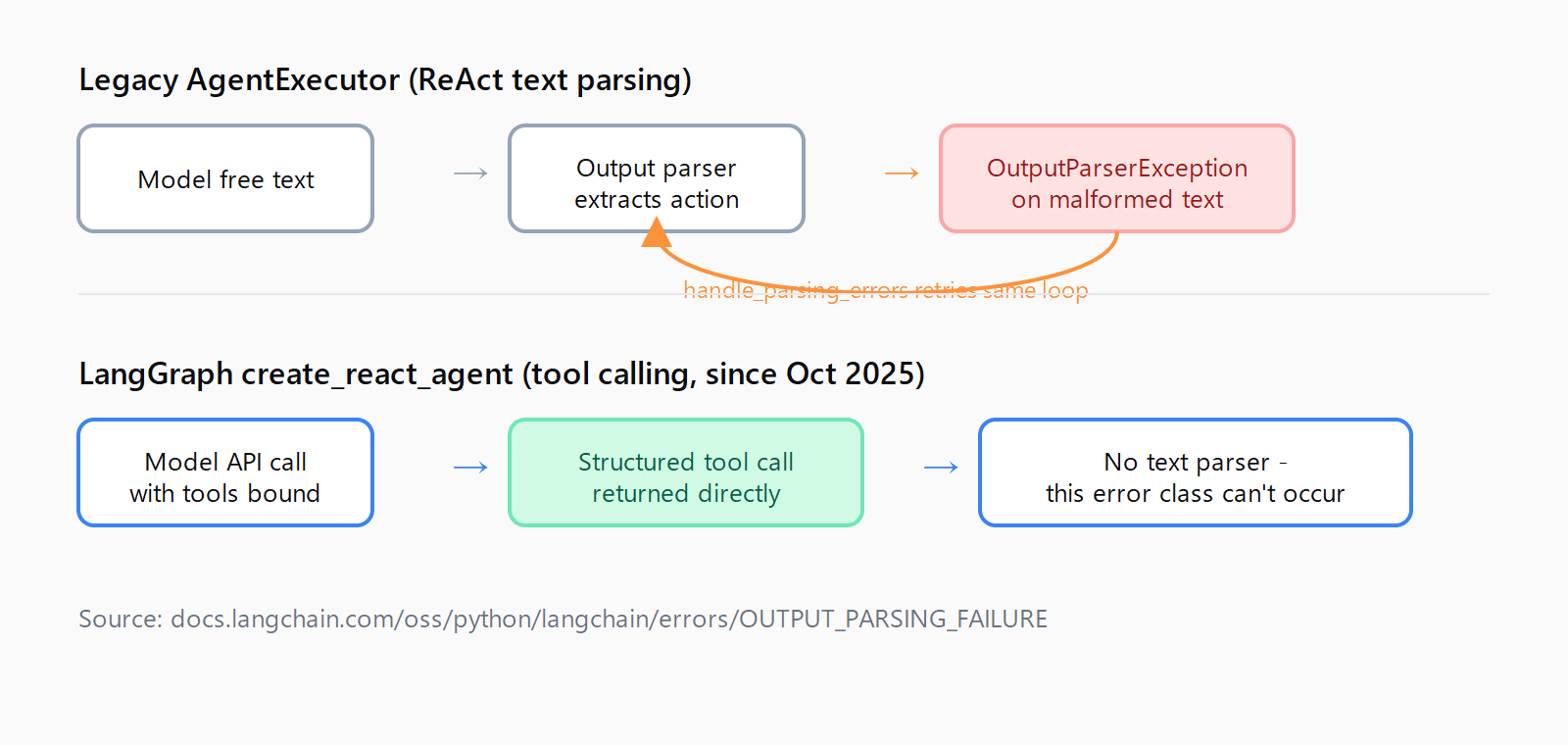
When the agent's output parser can't extract an action or a final answer from the model's raw text, LangChain raises an OutputParserException. handle_parsing_errors=True catches that exception, feeds the parsing failure back into the agent's scratchpad as an observation, and lets the model try again on the next loop iteration. It does not change the prompt template, the output format the model is asked to produce, or the model's ability to follow that format. If the root problem is a model that intermittently drifts from the exact "Thought: / Action: / Action Input:" text structure the ReAct parser expects, retrying with the same instructions produces the same drift.
Why does the error keep happening with the flag already set?
Per LangChain's own troubleshooting documentation, an output parser fails when it "was unable to handle model output as expected" - and legacy agents and chains can hit this even when you never wrote an output parser yourself, because the classic AgentExecutor ReAct loop uses one internally to turn free-text completions into structured actions. Smaller or less capable models are more likely to drop the exact formatting the parser needs, especially across multi-step tool calls where one malformed line breaks the whole loop.
What does LangChain recommend instead of patching the parser?
LangChain's current guidance is explicit: use tool calling or another structured-output technique instead of relying on an output parser at all, tighten the prompt's formatting instructions if you can't switch architectures yet, and move to a more capable model if the failures cluster on complex multi-step tasks. Tool-calling agents ask the model's API to return a structured function call directly - there's no free-text "Thought:/Action:" block for a parser to misread, so this entire error class doesn't apply.
This isn't a minor doc update. Since October 2025, LangChain's create_react_agent constructor delegates its execution loop to LangGraph internally, which runs on native tool calling rather than the old text-parsing ReAct loop. If you're building a new agent and reaching for create_react_agent, you may already be past this failure mode without realizing it - the bug largely lives in code still wired to the legacy initialize_agent / manual AgentExecutor pattern from pre-2025 tutorials.
How do you migrate an existing AgentExecutor off the legacy parser?
Three options, in order of effort:
# 1. Swap the LLM output method to structured tool calling (same AgentExecutor)
llm_with_tools = llm.bind_tools(tools)

# 2. Or move to LangGraph's tool-calling agent constructor
from langgraph.prebuilt import create_react_agent
agent = create_react_agent(llm, tools)

# 3. Interim patch if you can't migrate yet: pass a callable, not True
def handle_error(error) -> str:
    return f"Parsing failed: {error}. Reformat as a single Action/Action Input pair."

agent_executor = AgentExecutor(agent=agent, tools=tools, handle_parsing_errors=handle_error)
Option 3 buys time - a callable gives the model a more specific correction than the generic retry message True sends - but it's still patching a parser that's built to fail intermittently on free text. Options 1 and 2 remove the parsing step entirely and are what LangChain vs LangGraph covers in more depth for picking between them. For a related legacy-loop failure, see the iteration limit error, which hits the same AgentExecutor class of agent.
If your setup involves MCP tools instead of native LangChain tools, parsing failures can also surface through the MCP client layer - see the MultiServerMCPClient Windows fix for that adjacent failure mode.
FAQ
Does a custom OutputParser fix the error?
It can reduce the failure rate by parsing more output shapes, but it doesn't eliminate the class of error - a custom parser is still trying to extract structure from free text the model wasn't guaranteed to produce correctly. Tool calling removes the parsing step instead of improving it.
Is AgentExecutor deprecated?
It isn't formally deprecated, but LangChain's own create_react_agent has delegated to LangGraph internally since October 2025, and the framework's documentation now steers new agents toward tool calling rather than the legacy text-parsing loop that AgentExecutor was built around.
Does switching to LangGraph require a full rewrite?
Not for a simple ReAct-style agent - langgraph.prebuilt.create_react_agent accepts the same LLM and tools list as a drop-in replacement in most cases. Custom AgentExecutor subclasses or non-standard prompt templates need more migration work.
Does using a more capable model fix it?
Often, yes - larger models follow strict output formatting instructions more consistently, which is why LangChain lists it as one of the three recommended mitigations. It reduces the failure rate but doesn't remove the underlying fragility of parsing free text.
Can handle_parsing_errors take something other than True?
Yes - it accepts a string (sent verbatim as the retry observation) or a callable that receives the exception and returns a custom message. A callable lets you give the model a more targeted correction than the generic built-in retry text.