
Codex vs Claude Code: OpenAI and Anthropic Coding Agents Compared
Codex runs everywhere and can offload to the cloud; Claude Code stays local in your terminal. A side-by-side on surfaces, pricing, models, and which to pick.
TL;DR: Pick Codex if you want one agent across web, CLI, IDE, and desktop with optional cloud execution; pick Claude Code if you want a local-first terminal agent that runs entirely on your machine against your real git repo.
Both are agentic coding tools from the two frontier labs - Codex from OpenAI, Claude Code from Anthropic - and both let you hand a task to a model that reads files, writes code, and runs commands. They diverge on where the work happens and how you pay for it, and that difference decides which one fits your workflow.
What is the quick verdict on Codex vs Claude Code?
Codex is built to be everywhere: OpenAI ships it as a web agent, an open command-line tool, IDE extensions, an iOS app, and a desktop app, and it can run a task in a cloud container while you close your laptop. Claude Code takes the opposite stance - it is a terminal-native agent that reads your local filesystem, executes in your actual shell, and uses your local git setup, calling the Anthropic API only to think. If you live in the terminal and want nothing leaving your machine except prompts, Claude Code is the tighter fit. If you want to delegate long jobs to the cloud and pick them up from any surface, Codex wins.
How are Codex and Claude Code different in approach?
The architectural split is the whole story. Codex treats coding as something you can start on one surface and finish on another - kick off a refactor from the web agent, review the diff on your phone, merge from the CLI. That breadth is why OpenAI runs Codex across five surfaces, with cloud containers doing the heavy lifting when you want them to.
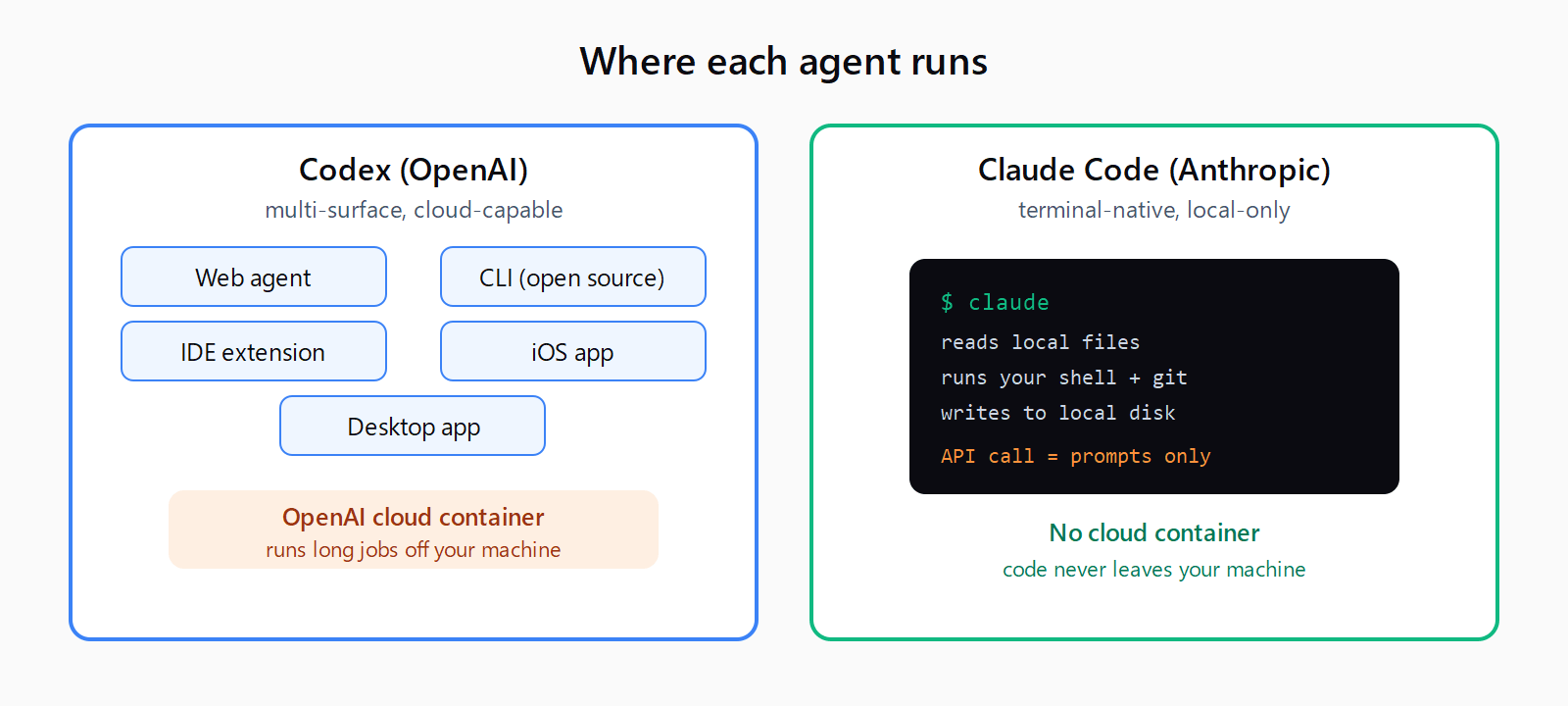
Claude Code is deliberately narrow. It runs in your terminal, sees the same files your editor sees, and never ships your code to a container - the model processes your prompts and the tool applies changes locally. That makes it predictable for anyone who already works from a shell and cares about keeping the codebase on disk. It also pairs cleanly with the rest of a local toolchain; you can extend it by connecting MCP servers to Claude Code for database access, browser control, or internal APIs.
How do Codex and Claude Code pricing and limits compare?
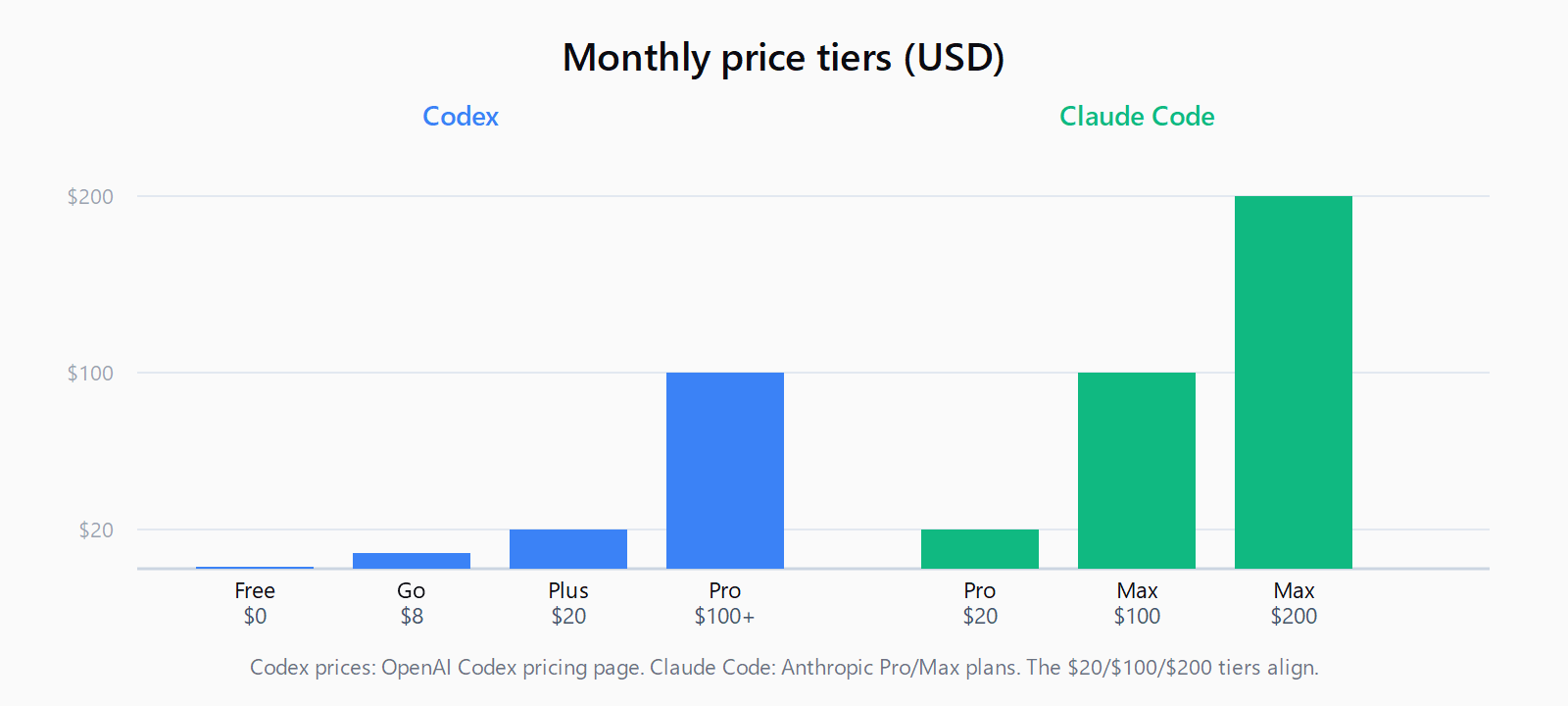
Both labs sell tiered subscriptions that gate how much agent usage you get. Per the OpenAI Codex pricing page, Codex offers Free ($0), Go ($8/month), Plus ($20/month), and Pro (from $100/month at 5x or 20x the Plus rate limits). Usage is metered in messages per 5-hour window - Plus allows roughly 15-80 messages per window on the top model, Pro 5x allows 80-400, and Pro 20x allows 300-1600.
Anthropic gates Claude Code through its Pro ($20/month) and Max plans ($100/month and $200/month), or pay-as-you-go through the Anthropic API. The two pricing ladders line up closely at the $20, $100, and $200 marks, so cost is rarely the deciding factor - the question is whether you want cloud delegation (Codex) or local-only execution (Claude Code) for that money.
Which models and context windows do they run?
Codex runs OpenAI's GPT-5.5 and the GPT-5.4 family, including a Codex-tuned variant. Claude Code runs Anthropic's current Claude models (the Opus and Sonnet line). Both expose very large context windows - on the order of a million tokens at the top tier - which in practice means either tool can hold a mid-sized repository in working memory. Raw model leaderboards swing with every release and the gap between the two is usually within a point or two on standard benchmarks, so picking on this quarter's SWE-bench number is a poor long-term bet. Choose on workflow, not on a score that changes next month.
Which is safer for proprietary code?
For teams under strict data-handling rules, the execution model matters more than the feature list. Claude Code keeps the codebase on the machine it runs on - the model never receives the repository as a whole, only the slices the agent reads to answer a prompt, and changes are written to local disk. That narrows the surface you have to reason about in a security review to a single API boundary. Codex's cloud surfaces are convenient precisely because they move work off your machine, which means a cloud run sends code to an OpenAI container; for some shops that is fine, for others it is a non-starter. If your compliance answer is "nothing leaves the building," Claude Code's local-only execution is the cleaner story, and you can still get cloud-style parallelism by running multiple local sessions. Decide this before you decide on features - it can rule one tool out entirely.
Which should you pick?
Pick Codex if you want a single agent that follows you across devices, you like delegating long-running tasks to a cloud container, or your team already lives in the ChatGPT ecosystem. The multi-surface reach and the $8 Go tier make it the easier on-ramp for people who do not work primarily from a terminal.
Pick Claude Code if you work from the command line, you want your code to stay on your machine, and you value tight git and shell integration over multi-device reach. It is the better fit for engineers who treat the terminal as home and want an agent that respects that. If you are also weighing the editor-based option, our Cursor versus Claude Code comparison covers the IDE side of the same decision, and our look at Notion's custom agents against Claude Code covers the no-code-adjacent angle.
How do you decide in five minutes?
- Ask where you work: terminal-first leans Claude Code, multi-surface leans Codex.
- Ask whether code can leave your machine: if no, Claude Code's local-only execution is the safer default.
- Ask whether you need cloud delegation for long jobs: if yes, Codex's cloud containers settle it.
- Match the price tier you will actually use - both run $20, $100, and $200 ladders, so pick on workflow, not cost.
- Trial both for a week on the same task; the agent whose output you stop re-reading is the one to keep.
FAQ
Is Codex or Claude Code better for terminal work?
Claude Code is the more terminal-native of the two - it runs in your shell, reads local files, and uses your local git. Codex has a CLI too, but it is one of five surfaces rather than the whole product.
Does Claude Code run my code in the cloud?
No. Claude Code executes locally on your machine and only sends prompts to the Anthropic API for processing. Codex can run tasks in cloud containers if you choose that surface.
How much do Codex and Claude Code cost?
Codex offers Free, Go at $8, Plus at $20, and Pro from $100 per month. Claude Code is sold through Anthropic's Pro at $20 and Max plans at $100 and $200 per month, or pay-as-you-go via the API.
Can I use both Codex and Claude Code?
Yes. Many engineers keep Claude Code for local terminal work and reach for Codex when they want cloud delegation or to continue a task from another device. The subscriptions are independent.
Which has the bigger context window?
Both expose roughly a million tokens of context at their top tiers, enough to hold a mid-sized repository. The difference is marginal and not a strong reason to pick one over the other.