
Launching the seo-performance MCP
A post-publish SEO MCP that unifies GSC, GA4, Matomo, Clarity, and AI-citation signals per URL and emits a verdict per post with reason codes.
TL;DR: seo-performance-mcp pulls Google Search Console, GA4, Matomo, Clarity, and AI-citation data per URL and emits a verdict per post (refresh, expand, merge, kill, double_down, hold) with explicit reason codes.
We just published @automatelab/seo-performance-mcp on npm. It is a Model Context Protocol server for the part of SEO that starts after the post goes live: triage. Which URLs are decaying, which are quietly winning, which lost an AI citation last week, which sit at position 7 with a low CTR and want a title rewrite. Free, MIT-licensed, no email gate.
What does seo-performance-mcp do?
Most SEO tooling stops at "the post is live." This MCP starts there. For any URL on your site it pulls Search Console (clicks, impressions, CTR, position, top queries), GA4 (pageviews), Matomo (visits, dwell), Microsoft Clarity (scroll depth, rage clicks), and AI-citation counts from a configured citation-intelligence endpoint. Every signal source is optional. Provide the env vars for the platforms you use; the rest are skipped silently.
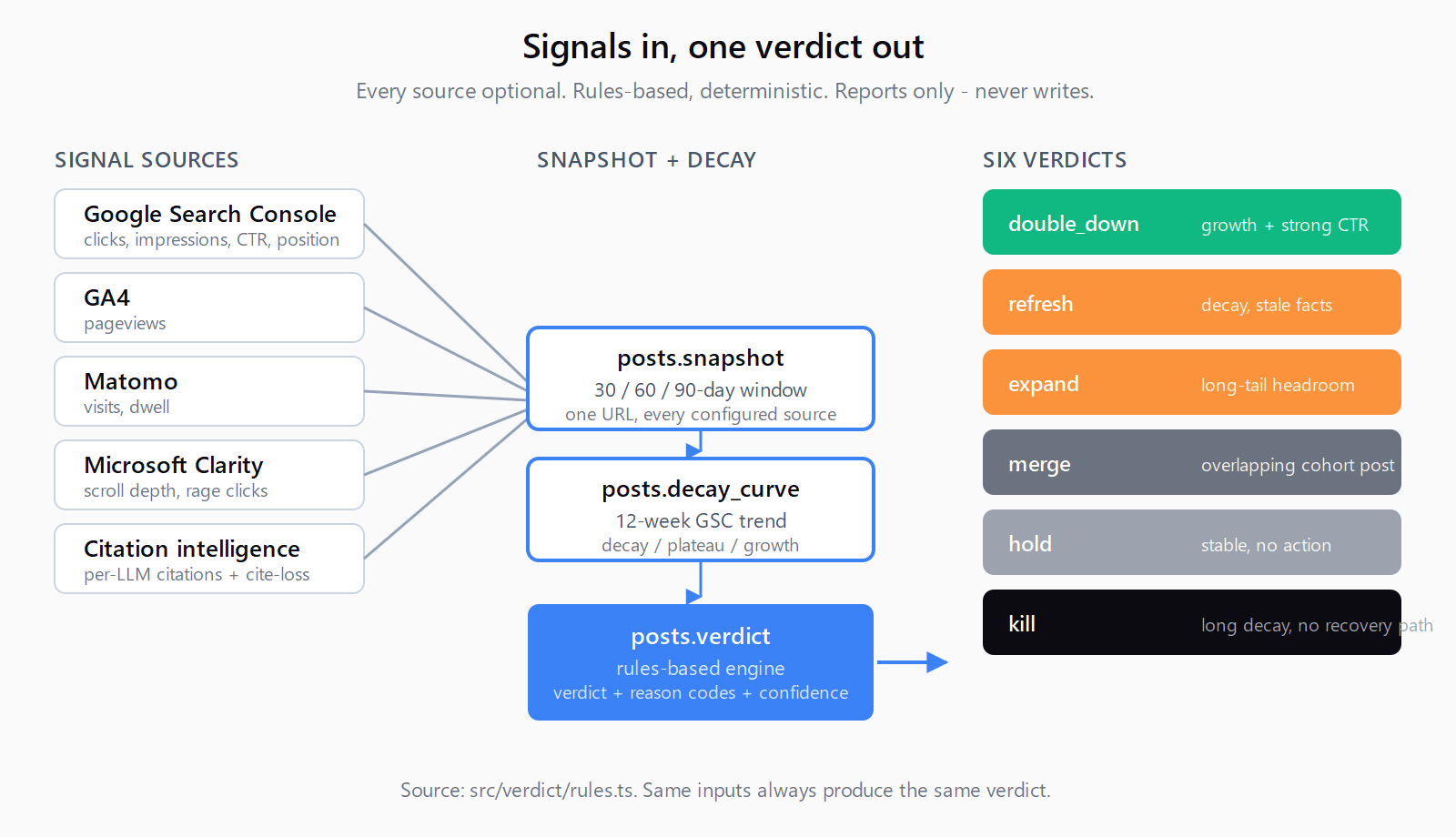
The data flows through a deterministic verdict engine. It combines the snapshot with a 12-week GSC decay curve and emits one of six calls per post: refresh, expand, merge, kill, double_down, or hold. Each verdict carries explicit reason codes (the rules live in src/verdict/rules.ts and can be inspected) and a 0-1 confidence score. The mapping is rules-based, not LLM-based, so the same inputs always produce the same call.
Reporting only. The server never edits a post, never publishes anything, never touches a third-party platform with anything other than a read. The verdict and the refresh brief are hand-off artefacts for a writer, an editor, or a downstream rewrite tool.
Which tools does it ship?
Eight tools, organised as a dot-notation tree: posts.* for per-URL analysis, cohort.* for cross-post roll-ups, gsc.* for direct Search Console scans.
posts.list: Discover indexable posts via an XML sitemap, a JSON override list, or the Ghost Admin API. Filter by minimum age or published-after date.posts.snapshot: Pull a 30, 60, or 90-day snapshot across every configured signal source for one URL. Each source is best-effort.posts.decay_curve: Bucket GSC clicks, impressions, and average position into weekly windows and classify the trend: decay, plateau, or growth. Underpins the verdict engine's decay rules.posts.verdict: Run the rule-based verdict engine on one URL. Returns verdict, reason codes, and confidence.posts.refresh_brief: Produce a markdown brief for a human or downstream LLM editor: verdict, reasons, raw numbers, top queries, suggested actions.posts.cite_loss: Return the list of LLMs that previously cited this URL but no longer do, with the prior query and last-seen date. Optionally identifies the URL that replaced yours.cohort.report: Run the verdict engine across a cohort filtered by tag and minimum age. Returns a ranked table sorted by verdict priority then confidence. Answers "which three posts should I refresh this week?"gsc.quick_wins: Scan GSC for (page, query) pairs at positions 5 to 15 with non-trivial impressions and a CTR below the position-expected curve. The fastest title-rewrite wins. Platform-agnostic pure GSC pull.
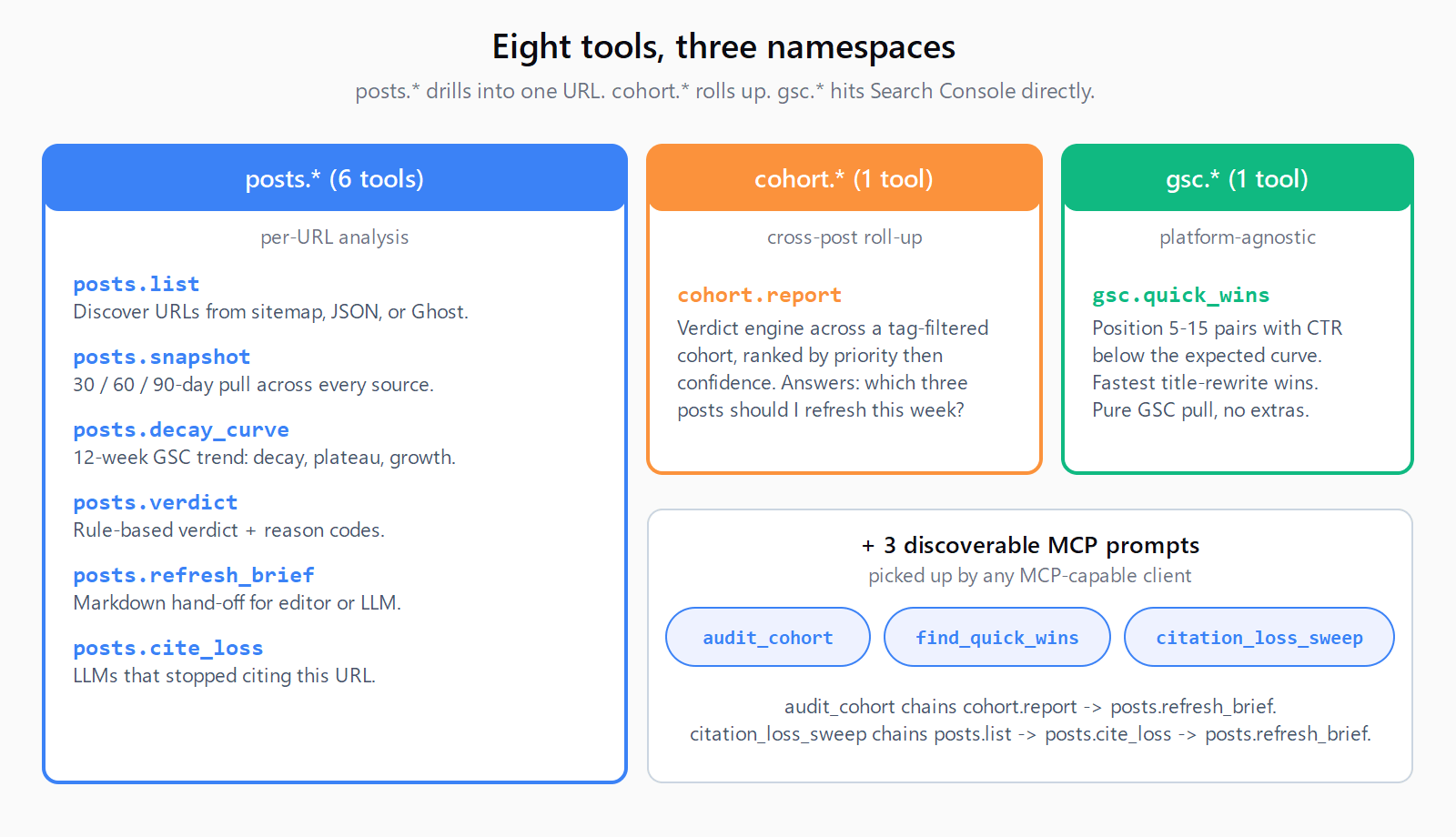
Three discoverable prompts ship alongside: audit_cohort, find_quick_wins, citation_loss_sweep. No skill loader required; any MCP-capable client picks them up.
Install
Requires Node 20+. Add the server to your MCP host config (~/.cursor/mcp.json for Cursor, claude_desktop_config.json for Claude Desktop, .mcp.json for Claude Code), then restart the host.
{
  "mcpServers": {
    "seo-performance": {
      "command": "npx",
      "args": ["-y", "@automatelab/seo-performance-mcp"],
      "env": {
        "GSC_SERVICE_ACCOUNT_JSON": "/abs/path/to/gsc-service-account.json",
        "GSC_SITE_URL": "sc-domain:example.com",
        "MATOMO_BASE_URL": "https://example.com/analytics",
        "MATOMO_TOKEN": "...",
        "MATOMO_SITE_ID": "1",
        "GA4_PROPERTY_ID": "123456789",
        "CLARITY_PROJECT_ID": "...",
        "GHOST_ADMIN_KEY": "id:secret"
      }
    }
  }
}
Every env var is optional. Provide the ones you have; the rest are skipped at runtime. Discovery falls back to a sitemap if Ghost is not configured.
What does a weekly run look like?
The intended loop, run from a chat with any MCP-capable agent:
Runcohort.reporton posts older than 90 days, window 30, limit 20. For every row with verdictrefresh,expand,merge, ordouble_down, callposts.refresh_brief. Sort by verdict priority then confidence and pick the top three to act on this week.
The same prompt ships as the audit_cohort MCP prompt, so it appears in your client's prompt menu without any setup. find_quick_wins does the same for position 5-15 SERP rewrites; citation_loss_sweep chains posts.list into posts.cite_loss into posts.refresh_brief for any URLs that lost LLM citations.
The verdict is reporting, not action. The brief tells you which URL to touch and why. Whether the rewrite happens in Cursor, in Claude Code, or in a human editor's tab, is up to you.
Links
- Product page: full tool reference and config.
- GitHub repo: source, issues, releases.
- npm package:
@automatelab/seo-performance-mcp. - All AutomateLab MCPs: ai-seo, n8n-mcp, content-distribution, citation-intelligence, seo-performance.