
n8n vs Make in 2026: pricing, execution limits, and when to pick which
n8n charges per workflow run regardless of node count and lets you self-host; Make charges per module action and is SaaS-only. 2026 plan tables, the cost-counting gap, and when to pick which.
TL;DR: n8n charges per workflow run regardless of how many nodes execute and lets you self-host the Community Edition under the Sustainable Use License; Make charges per module action (a 10-step scenario run = 10 credits) and is SaaS-only. Pick n8n when nodes-per-run is high or you need on-prem; pick Make when scenarios are short, the team wants zero-ops, and the visual editor matters more than execution math.
"Which one is cheaper?" is the wrong opening question. The two platforms count usage on different axes - n8n meters whole workflow runs, Make meters every module step inside a scenario - so the same automation can cost very different amounts on each. The 2026 plan tables below show that gap.
How do n8n and Make prices compare in 2026?
Both companies refreshed plan tables in early 2026. Prices below are annual-billing rates pulled from n8n.io/pricing and make.com/pricing.
n8n Cloud
| Plan | Price (annual) | Executions / month | Concurrent | History |
|---|---|---|---|---|
| Starter | EUR 20/mo | 2,500 | 5 | 1 day |
| Pro | EUR 50/mo | 10,000 | 20 | 5 days |
| Business | EUR 667/mo | 40,000 | 30 | 30 days |
| Enterprise | Contact sales | Custom | 200+ | 365 days |
Every n8n plan advertises "unlimited steps" per execution. There is no Free Cloud tier; the free path is the self-hosted Community Edition.
Make
| Plan | Price (annual) | Credits / month | Min interval | Scenario timeout |
|---|---|---|---|---|
| Free | USD 0 | 1,000 | 15 min | 5 min |
| Core | USD 9/mo | 10,000 | 1 min | 40 min |
| Pro | USD 16/mo | 10,000 | 1 min | 40 min |
| Teams | USD 29/mo | 10,000 | 1 min | 40 min |
| Enterprise | Custom | Custom | 1 min | 40 min |
Make renamed "operations" to "credits" in 2026, but the meter is the same: each module action in your scenario, like adding a Google Sheet row or fetching a Gmail message, counts as one credit. Core, Pro, and Teams share the same 10,000-credit ceiling - the price gaps buy collaboration features (Pro adds operations sequencing, Teams adds team roles), not more headroom.
How do n8n and Make count executions differently?
The single sentence that explains 80% of the cost differences:
- n8n charges per workflow run. A workflow with two nodes and a workflow with twenty nodes both consume one execution per trigger.
- Make charges per module action. A scenario with two modules consumes two credits per run; a scenario with twenty modules consumes twenty.
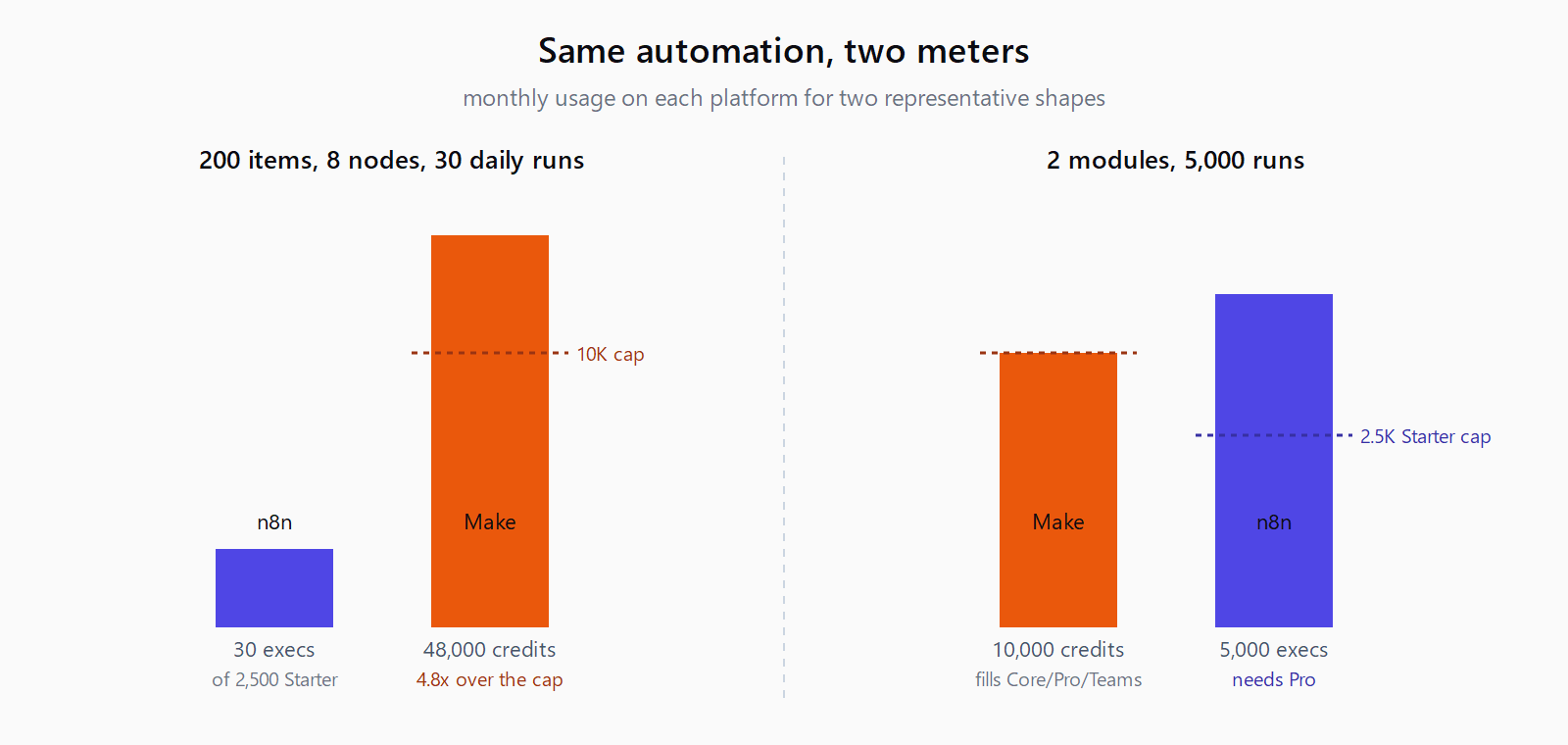
Work the math both ways on a representative shape - a daily sync that pulls 200 rows from Postgres, transforms each row, and writes it to HubSpot:
| Shape | n8n cost | Make cost |
|---|---|---|
| 1 run, 200 items, 8-node pipeline | 1 execution | 200 x 8 = 1,600 credits |
| 30 daily runs over a month | 30 executions | 30 x 1,600 = 48,000 credits (4.8x over the 10,000 cap) |
The same shape sits inside n8n Cloud's Starter plan (30 of 2,500 executions used) and overshoots Make's Teams plan by 4.8x. The asymmetry inverts on short, low-volume scenarios: a 2-module Make scenario that fires 5,000 times a month burns 10,000 credits, while the same logic on n8n eats 5,000 of Starter's 2,500-execution budget and needs a Pro upgrade.
How do n8n and Make differ on self-hosting and licensing?
n8n's Community Edition is open-source under the Sustainable Use License v1.0: free to run, modify, and distribute for internal business purposes; commercial resale requires a separate n8n Enterprise license. Files marked .ee. in the repo are under the Enterprise License only. Self-hosted instances have no per-month execution cap - the only ceilings are the box's CPU, memory, and database I/O. A reasonable VPS handles tens of thousands of executions a day; the walk-through to self-host n8n on a $5 VPS covers the install end to end.
Make has no self-hosted edition. The platform is SaaS-only - the Free plan exists, but the 1,000-credit cap and 15-minute minimum interval make it a sandbox, not a runtime for production work.
What execution limits does each platform impose?
Make stops a scenario when its wall-clock exceeds the plan's maximum execution time - 5 minutes on Free, 40 minutes on Core, Pro, Teams, and Enterprise (a private White Label instance can go to 60). The interrupt is raised by the scenario engine, not by any module, so per-module handlers do not catch it; the separate fix-post on Make's 40-minute scenario hard limit covers the workaround. There is also a 40-second per-module HTTP timeout that does behave like a regular module error.
n8n self-hosted has no equivalent platform-imposed wall-clock; n8n Cloud caps individual node executions but documents no aggregate scenario-level timeout. The trade is concurrency: n8n Starter allows 5 concurrent executions, Pro 20, Business 30. Make does not advertise a concurrency cap on Core/Pro/Teams, but each scenario respects the configured minimum interval (1 minute on paid plans).
When should you pick n8n vs Make?
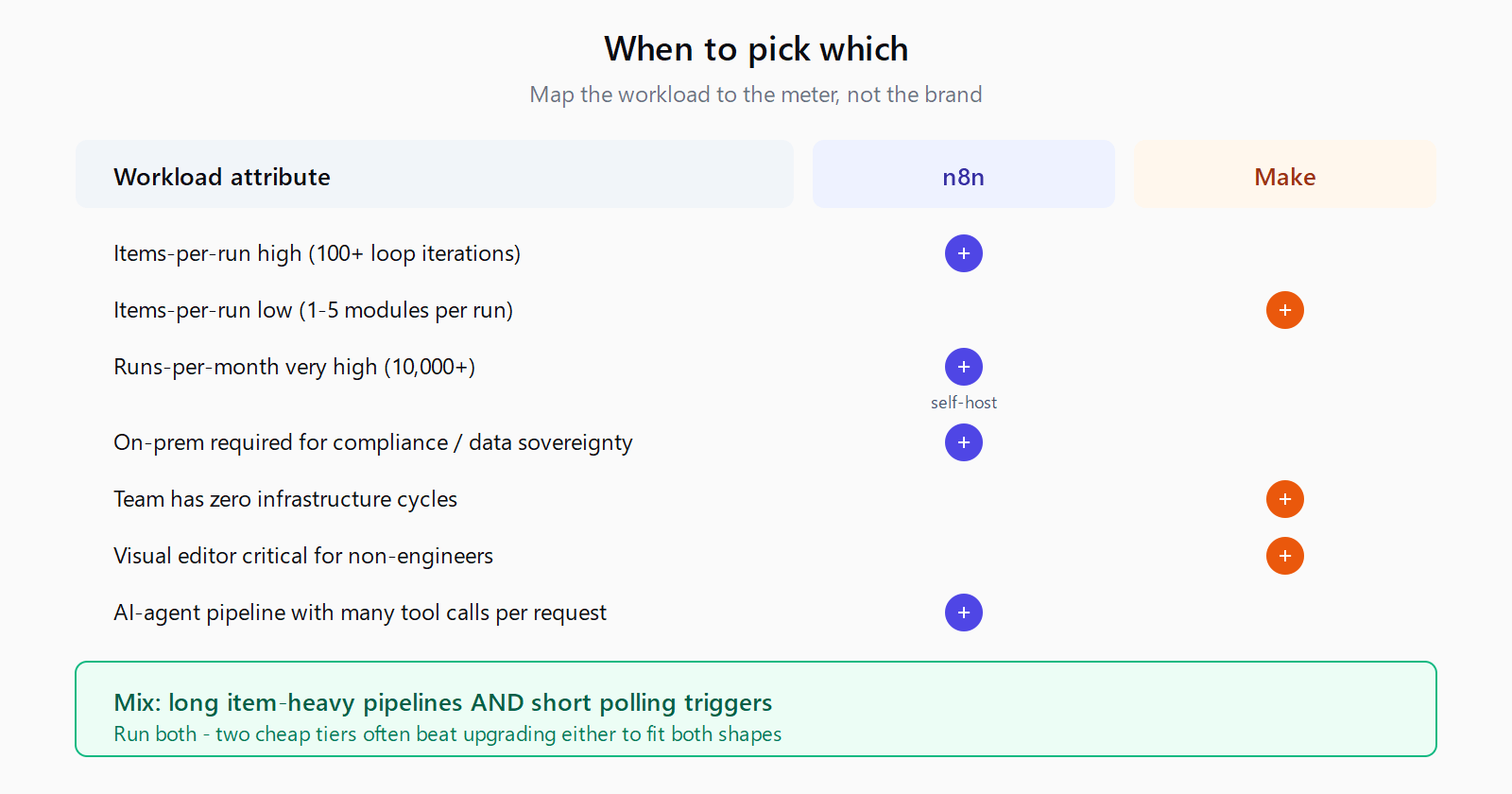
- Pick n8n when any run loops over hundreds of items, when you need on-prem execution for compliance, when the team has the ops cycles to maintain a self-hosted box, or when AI-agent pipelines with many tool calls per request would burn through Make's per-module meter.
- Pick Make when scenarios are short (one to ten modules), volume is moderate, the team wants zero infrastructure to babysit, and the visual editor's branching pattern is more legible to non-engineers than n8n's node graph.
- Run both when a single team has both shapes - long, item-heavy pipelines on n8n; short, polling-style triggers on Make - paying for two cheap tiers is often less than upgrading either to a plan that fits both.
FAQ
Is n8n really free if I self-host?
Yes, under the Sustainable Use License v1.0. The Community Edition is free to run on your own infrastructure for internal business purposes. Enterprise features (SAML SSO, RBAC, log streaming) are gated by the n8n Enterprise license and live in the .ee.-suffixed files in the repo.
Why is Make so much more expensive at the same plan price?
It usually is not - the difference is the meter. Make charges per module action, so a 10-module scenario running 1,000 times equals 10,000 credits, which fills the entire Core/Pro/Teams ceiling. n8n charges per workflow run, so the same logic packed into one workflow costs 1,000 executions of Pro's 10,000-execution budget. For short, high-frequency scenarios Make is cheaper; for long, item-heavy pipelines n8n is.
Can I migrate from Make to n8n or vice versa?
There is no automatic converter. The data models differ - Make's bundles are roughly equivalent to n8n's items, but error handler topology, iterator behaviour, and credential storage do not map one-to-one. Practical migrations rebuild scenarios in the target tool while keeping the source running, then cut over per workflow.
Which one has the bigger integration catalog?
Make publishes ~1,800 vendor integrations as of 2026; n8n ships hundreds of first-party nodes plus a community-nodes pipeline that pulls third-party packages from npm. Raw count favours Make; long-tail coverage favours n8n once you accept community nodes and the HTTP Request node as fallbacks.
Which one does AutomateLab recommend in 2026?
For most teams running automation as a side concern, Make on Core or Pro is the lowest-effort path. For teams that already self-host other infrastructure, n8n Community Edition on a small VPS is the cheapest path to unlimited executions and the strongest fit for AI-heavy workloads. If you are paying n8n Cloud Business prices (EUR 667/mo), self-hosting is almost always the better deal.