
How to fix n8n webhook returning 403 instead of 401 for invalid Basic Auth
n8n returns 403 Forbidden (not 401) when Basic Auth credentials are wrong - breaking browser re-challenge flows. Three workarounds: nginx proxy, Header Auth, or the pending patch in PR #26402.
TL;DR: n8n webhooks return 403 (not 401) for wrong Basic Auth credentials, violating RFC 7235 - fix it with an nginx reverse proxy or wait for the patch tracked in GitHub issue #26365.
You configure a Basic Auth credential on your n8n webhook, send a request with the wrong password, and get back a 403 Forbidden. You try with no credentials at all and get a 401 Unauthorized. That is backwards - or more precisely, the 403 is wrong. This is a known n8n webhook bug filed in February 2026 (v2.9.0+), and it breaks any client that uses standard browser-based authentication dialogs.
Why does n8n return 403 instead of 401 for bad credentials?
n8n's webhook node distinguishes between two failure states:
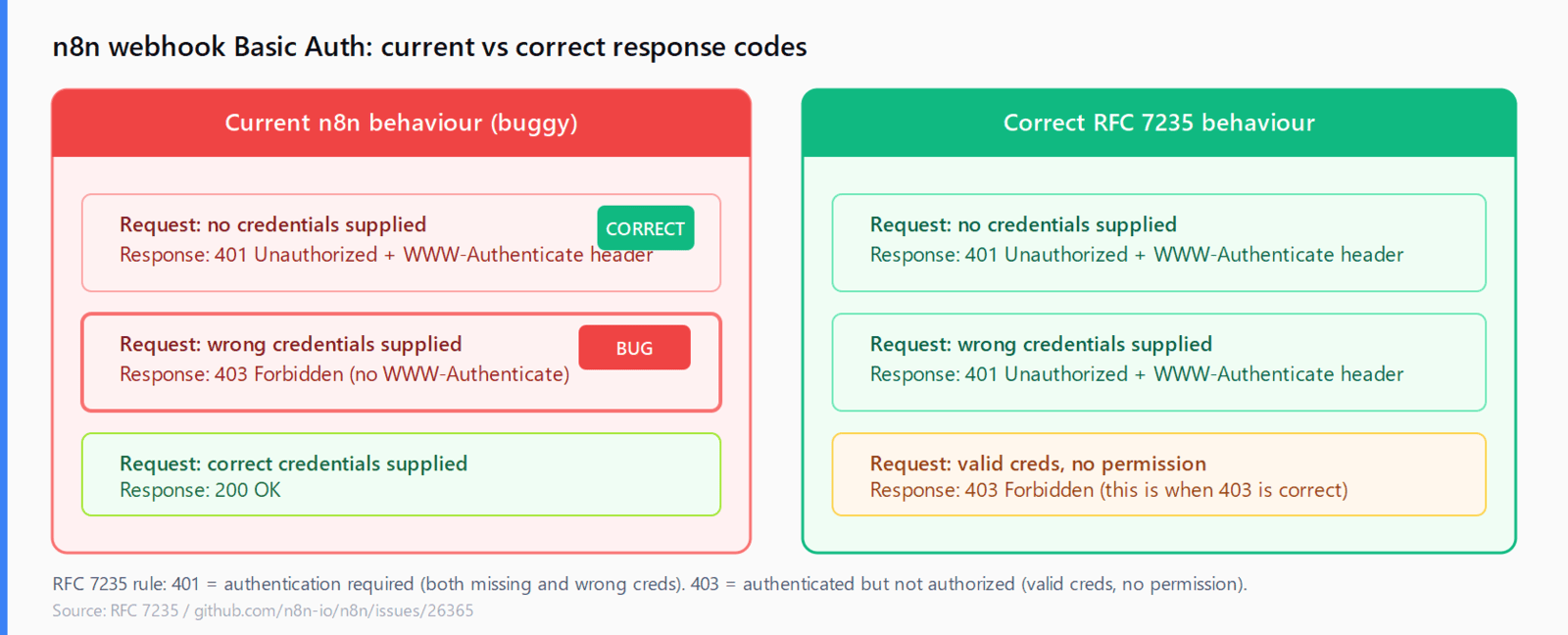
- No credentials supplied: returns 401 Unauthorized +
WWW-Authenticateheader (correct). - Wrong credentials supplied: returns 403 Forbidden (incorrect - this is the bug).
The difference matters because of what these codes mean in HTTP. 401 means "I don't know who you are yet - authenticate and try again." The server must include a WWW-Authenticate header naming the realm so the client knows what credentials to send. 403 means "I know who you are, but you are not allowed." Returning 403 for a wrong password signals that authentication succeeded but authorization failed - which is factually wrong when the password is simply incorrect.
RFC 7235 is explicit: a server receiving invalid or missing credentials MUST respond with 401 and a WWW-Authenticate header. n8n's webhook node violates this when credentials are present but wrong.
What breaks when you get 403 instead of 401?
The practical impact shows up in browser-based authentication flows. Browsers cache credentials per realm: when they receive a 401, they re-challenge the user and retry with the new credentials. When they receive a 403, they treat it as final and stop - no re-challenge, no retry, just a blocked request. This matters if you have multiple n8n webhooks configured with different usernames and passwords - a wrong credential on one endpoint blocks the browser from prompting for the correct realm credentials on another.
For server-to-server calls from curl, Postman, or application code the practical impact is smaller - a well-written client should handle both 401 and 403 as auth failures - but the wrong status code still confuses error handling logic and logs.
How do you fix or work around the 403 bug?
Three options, ordered by effort:
Option 1 - Wait for the patch. GitHub issue #26365 was triaged and a fix was proposed in PR #26402. Check the issue for a merged version before implementing a workaround.
Option 2 - Nginx reverse proxy (browser auth flows). Put nginx in front of n8n and handle Basic Auth at the proxy layer. nginx returns correct 401 responses with the proper realm header; n8n never sees the authentication check:
location /webhook/ {
    auth_basic "n8n Webhook";
    auth_basic_user_file /etc/nginx/.htpasswd;
    proxy_pass http://localhost:5678;
}
This keeps your n8n webhook unauthenticated internally while nginx enforces the credential check. Generate the .htpasswd file with htpasswd -c /etc/nginx/.htpasswd <username>. nginx returns 401 on missing credentials and 401 (not 403) on wrong credentials, which complies with RFC 7235.
Option 3 - Header Auth instead of Basic Auth. Switch the webhook authentication method from "Basic Auth" to "Header Auth" and use a static API key in a custom header (e.g. X-Webhook-Secret). This sidesteps the 403/401 inconsistency entirely and is the approach n8n recommends for webhook-to-webhook and automation-to-automation calls. Header Auth does not trigger browser authentication dialogs, which means Option 3 only works if the calling client supports setting custom headers.
How do you test which status code your webhook is returning?
Use curl with verbose output to see the exact response code and headers:
# No credentials - should be 401
curl -v https://your-n8n.example.com/webhook/your-path

# Wrong credentials - currently 403, should be 401
curl -v -u wronguser:wrongpassword https://your-n8n.example.com/webhook/your-path

# Correct credentials - should be 200
curl -v -u correctuser:correctpassword https://your-n8n.example.com/webhook/your-path
The -v flag shows response headers. A compliant 401 response includes a WWW-Authenticate: Basic realm="..." header line. A 403 response does not include WWW-Authenticate - that is the tell. For other webhook authentication issues like 404 responses, see the guide on n8n webhook 404 errors and the Automation Error Index for a full catalog of n8n HTTP errors.
FAQ
Why does n8n return 403 for wrong Basic Auth credentials?
n8n's webhook authentication treats missing credentials (401) and invalid credentials (403) as different failure states, but RFC 7235 requires 401 for both. The behavior is tracked as a bug in GitHub issue #26365.
What is the difference between HTTP 401 and 403 in webhook authentication?
401 means "authenticate and try again" - the server challenges the client with a WWW-Authenticate header specifying the realm. 403 means "you are authenticated but not permitted" - no re-challenge is implied and browsers treat it as final.
Does n8n send a WWW-Authenticate header on 401 responses?
Yes, when no credentials are supplied to a Basic Auth webhook, n8n returns 401 with a WWW-Authenticate header. The bug is the 403 case (wrong credentials), which does not include that header.
Which n8n version fixes the 403 Basic Auth webhook bug?
As of the filing date (February 2026, n8n 2.9.0), a fix was proposed in PR #26402. Check issue #26365 for the resolved version number before upgrading.
Does switching to Header Auth fix the problem?
Yes for server-to-server calls. Header Auth uses a static key in a custom request header and does not trigger browser authentication dialogs, so the 403/401 inconsistency does not apply. It is not a drop-in replacement for browser-side Basic Auth dialogs.
How do I report similar n8n HTTP authentication errors?
Check the Automation Error Index for documented n8n errors, then open a thread on the n8n community forum with your version, deployment method, and the curl output from the test commands above.