
UiPath vs Power Automate for Enterprise Scale in 2026
UiPath or Power Automate for a 100+ bot rollout? Here's the governance, cost, and AI-integration breakdown enterprise architects actually need in 2026.
TL;DR: At 100+ bots, UiPath wins on legacy UI automation and governance depth but costs 2-3x more per bot; Power Automate wins when most processes touch Microsoft 365 and governance runs on the free CoE Starter Kit.
Both platforms handle enterprise RPA. The decision at scale hinges on three things: how much of the automation estate touches legacy UI versus Microsoft 365, how the organization plans to staff governance, and whether the AI layer (UiPath AI Center versus Power Platform Copilot Studio agents) fits the existing model estate. See AutomateLab's the SMB comparison for the same match-up under 20 bots - the calculus flips hard past 100.
How do UiPath and Power Automate compare at 100+ bots?
| UiPath | Power Automate | |
|---|---|---|
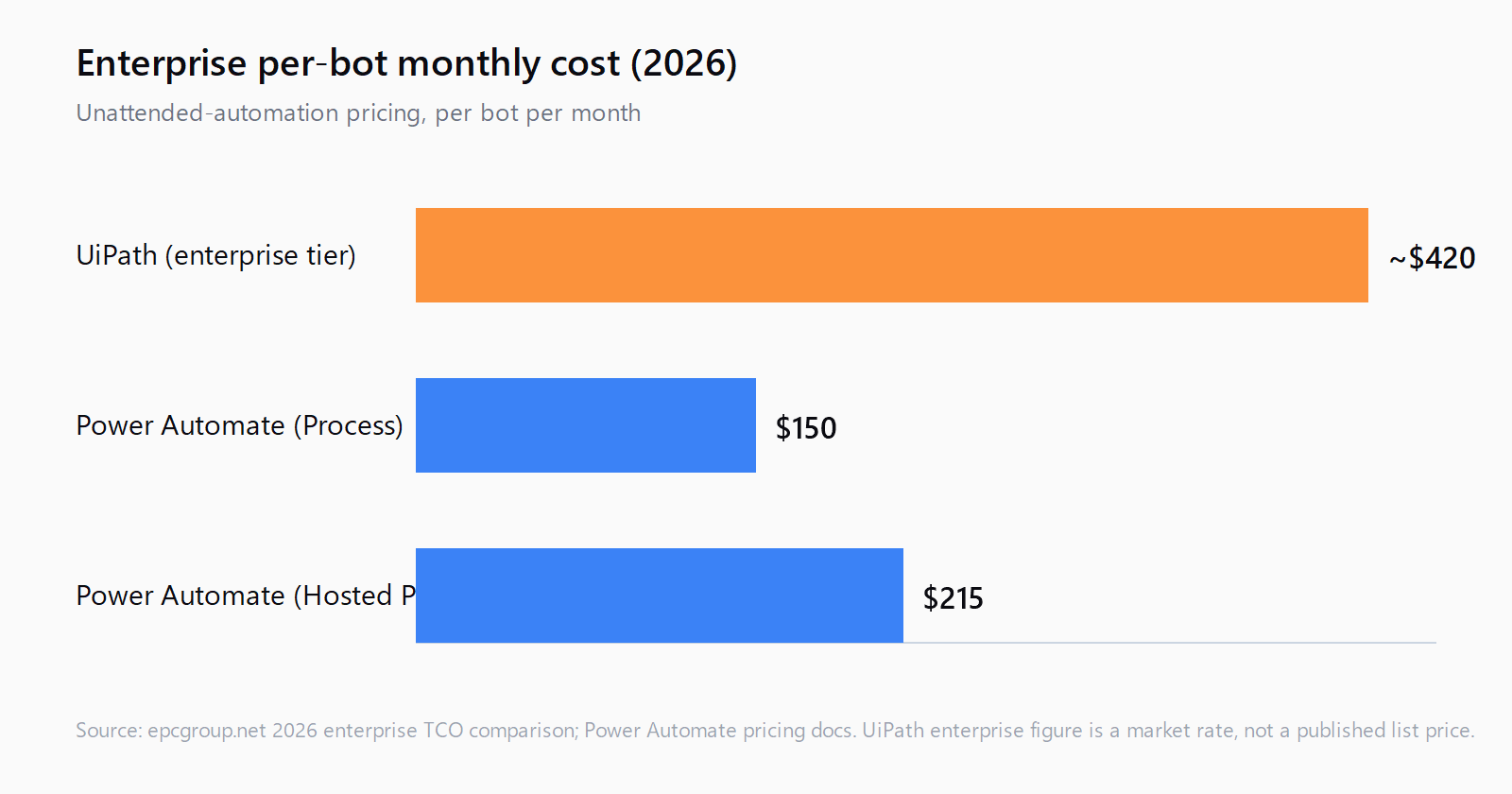
| Unattended bot pricing | ~$420+/user/month enterprise tier | $150/bot/month (Process), $215/bot/month (Hosted Process) |
| Governance console | Orchestrator - RBAC, tenant/folder structure, full audit trail | CoE Starter Kit - free, open-source, DLP + inventory dashboards |
| Governance staffing | 1-3 dedicated CoE FTEs typical | Runs on existing Power Platform admins |
| Legacy UI / Citrix / mainframe | Purpose-built, computer-vision targeting | Desktop flows exist but weaker on legacy UI |
| AI layer | AI Center (custom ML model deployment) | AI Builder + Copilot Studio agents |
| 50-automation TCO (Year 1) | ~$97k | ~$42k |
| Best for | Legacy-UI-heavy estates, dedicated RPA teams | M365-heavy estates, business-led CoE |
Where does UiPath win at enterprise scale?
UiPath's Orchestrator is the more mature governance console for a large bot fleet: it tracks every action a robot or a person takes, applies role-based access control, and integrates with enterprise credential stores like Active Directory groups and CyberArk Conjur Cloud. That audit depth matters for regulated industries running hundreds of unattended bots against production systems.
UiPath also remains the stronger pick for automations that live inside Citrix sessions, mainframe terminals, or desktop applications with no API - the computer-vision element targeting in UiPath Studio handles UI drift that Power Automate desktop flows struggle with. Enterprises with a large legacy-application footprint (banking cores, ERP terminal emulators) still route those processes through UiPath even when the rest of the estate runs on Power Automate.
Watch out for: the license line isn't the real cost. UiPath's governance model assumes a staffed Center of Excellence - typically 1-3 dedicated FTEs for pipeline management, bot monitoring, and Orchestrator administration. Enterprises that buy the bot licenses without budgeting that headcount see a fraction of the throughput; organizations that fund the full CoE see 3-4x the automation output of those that don't, per EPC Group's 2026 enterprise comparison.
Where does Power Automate win at enterprise scale?
Power Automate's 2026 pricing is materially cheaper per bot: the Process plan runs $150/bot/month for unattended automation, and the Hosted Process plan adds Microsoft-hosted infrastructure at $215/bot/month. Cloud flows on standard connectors - Outlook, Teams, SharePoint, OneDrive - are effectively included with a qualifying Microsoft 365 license, so an enterprise already paying for M365 adds cloud-flow automation at close to zero incremental license cost.
Governance is where the gap has narrowed the most since 2025: the Power Platform CoE Starter Kit is free, open-source, and gives inventory, compliance, and Data Loss Prevention (DLP) dashboards across the whole tenant - without the dedicated headcount UiPath's model assumes. In 2026, Copilot Studio agents also plug directly into Power Automate flows, giving citizen-developer teams an AI layer that used to require a separate UiPath AI Center deployment.
Watch out for: premium connectors (Salesforce, SAP, Oracle) require a paid license on top of the base plan, and desktop flows still lag UiPath on genuinely legacy UI - a mainframe terminal automation that's stable in UiPath can be brittle in Power Automate.
When to pick neither?
If fewer than 80% of processes touch either legacy UI or Microsoft 365 - a mixed estate spanning Salesforce, SAP, and custom web apps with real APIs - a lighter no-code platform (n8n or Make) can automate the API-reachable half at a fraction of either platform's per-bot cost, leaving RPA for the handful of processes that genuinely have no API. AutomateLab's breakdown of 24-month TCO comparison covers when an agentic workflow beats RPA entirely once exception rates climb.
How do you decide between UiPath and Power Automate at scale?
Run the audit before the pilot: tag every candidate process by whether it touches a legacy UI (Citrix, mainframe, no-API desktop app) or Microsoft 365 apps. If legacy UI accounts for more than a quarter of the estate, budget for UiPath plus a staffed CoE from day one - it is not a bolt-on. If Microsoft 365 dominates, start with Power Automate's Process plan and the free CoE Starter Kit, and add UiPath later only for the legacy-UI exceptions. Enterprises past 200-300 bots commonly run both, with UiPath scoped to the legacy tail.
FAQ
Can enterprises run UiPath and Power Automate together?
Yes - this is the common pattern past 200 bots. Power Automate handles the Microsoft 365-native majority of processes, while UiPath is scoped to the legacy-UI minority (Citrix, mainframe, no-API desktop apps) where it remains stronger.
What does a UiPath Center of Excellence cost per year?
Budget for 1-3 dedicated FTEs on top of bot licensing - governance, pipeline management, and Orchestrator administration. Skipping this line is the most common reason UiPath deployments underperform their throughput target.
Does Power Automate handle unattended RPA at UiPath's scale?
Yes, via the Process plan ($150/bot/month) or Hosted Process plan ($215/bot/month), both priced per concurrent bot rather than per user. It scales technically; the gap versus UiPath is depth on legacy UI targeting, not raw bot count.
How does Copilot Studio change the governance story in 2026?
Copilot Studio agents plug into Power Automate flows directly, giving business teams an AI layer without a separate AI Center-style deployment - narrowing one of UiPath's traditional advantages for citizen-developer-led automation programs.
Is the Power Platform CoE Starter Kit really free?
Yes - it is a free, open-source solution from Microsoft that adds inventory, compliance, and DLP dashboards on top of licenses the organization already holds, rather than requiring dedicated governance headcount.