
Vapi vs Retell for insurance voice agents in 2027
Compare Vapi and Retell for insurance calls: warm transfers, CRM actions, call capacity, pricing, and a practical pilot test for human handoff failures.

TL;DR: Choose Retell for configurable phone handoffs and workspace-level capacity; choose Vapi when an engineering team needs provider choice and can validate transfer behavior on its exact telephony route.
For an insurance agency, the buying test is whether a caller reaches the right person with the right context when automation stops helping. A fluent demo leaves the actual carrier route untested. Neither vendor's documentation establishes a universal reliability winner, and this comparison makes no claim of measured call quality.
Should an insurance agency choose Vapi or Retell?
Start with a narrow inbound job: identify the reason for calling, look up an existing contact, and connect the caller to an approved service queue. Keep coverage decisions and commitments outside the agent's permitted actions. Record which system owns the contact record and which phone system owns the human destination.
| Decision | Vapi | Retell AI |
|---|---|---|
| Human transfer | Phone or SIP destinations; mode compatibility depends on provider. | Cold, warm, and agentic warm transfer on phone calls. |
| Context before connection | Spoken summary modes commonly require Twilio; assistant-based mode has separate support. | Configure the selected warm-transfer mode and destination. |
| CRM integration | API Request or Function tools; engineering owns business rules. | Custom functions call your API during the conversation. |
| Entry capacity | 4 concurrent calls on usage only; Core includes 10. | 20 concurrent calls per pay-as-you-go workspace. |
| Commercial starting point | $0.05/min hosting plus providers and transport; optional packages. | Published voice-agent range $0.07-$0.31/min; inspect selected components. |
| Best fit | Custom provider and orchestration requirements. | Teams prioritizing a configured phone workflow and separate workspaces. |
Prices and documented limits were checked on 26 October 2026. The recommendations are an architectural judgment. A team with an existing Twilio implementation may prefer Vapi even for a simple workflow. A team needing unusual CRM behavior still needs backend development with Retell. Buying either service leaves someone responsible for routing rules and operational alerts.
What can go wrong with a warm transfer?
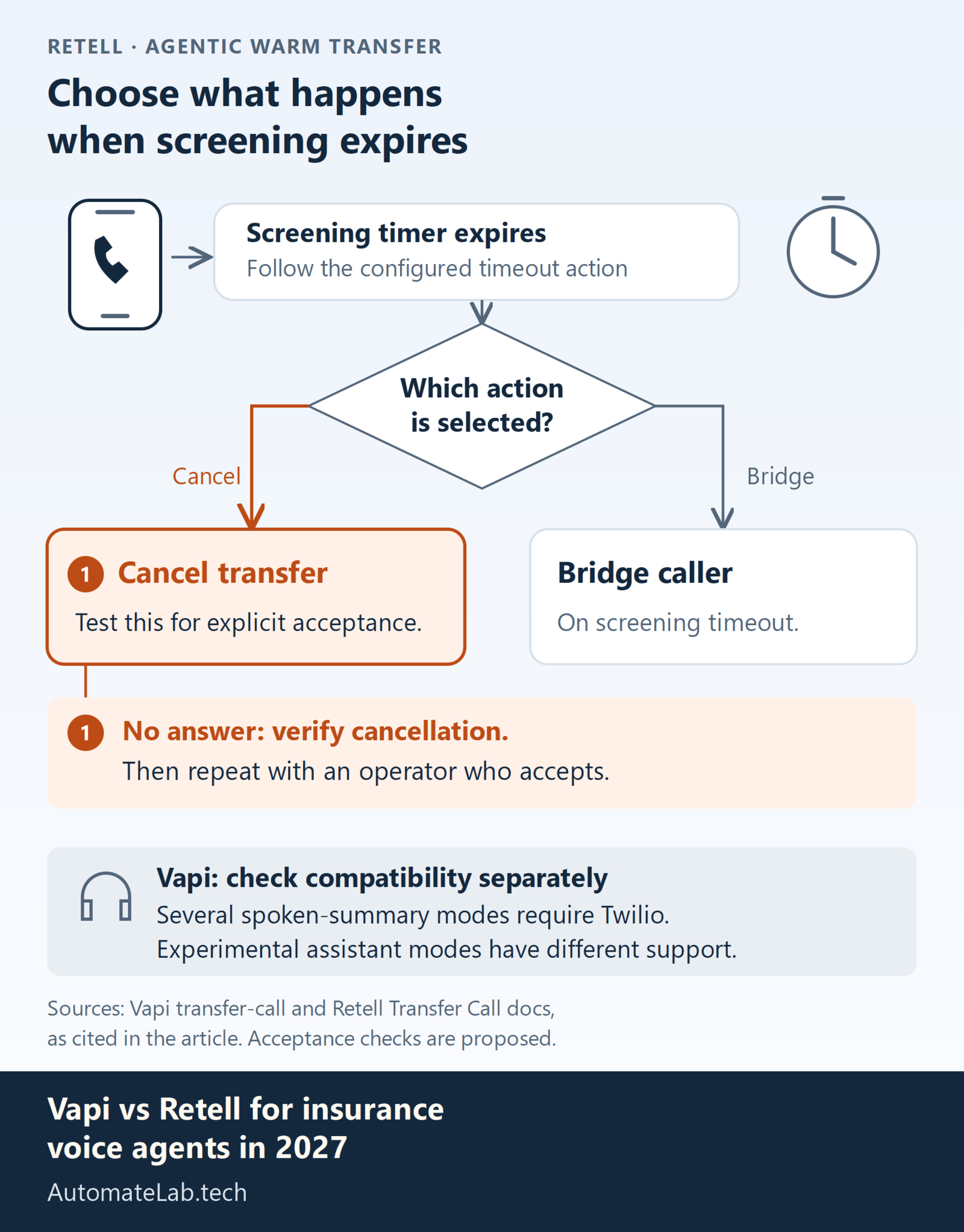
Vapi's transfer-call documentation distinguishes a spoken introduction from operator acceptance. Several message and summary modes are Twilio-only. With another provider, a transfer can proceed without the promised introduction. The assistant-based experimental mode has a different compatibility list and an explicit fallback plan.
The same document says assistant-forwarded-call means transfer was initiated or control delegated. It does not prove the destination answered. A dashboard can therefore show a handoff even when the caller never spoke to the service representative.
Retell's Transfer Call tool supports cold, warm, and agentic warm modes for phone calls, including imported numbers. A browser voice demo cannot exercise this tool. Test through the incoming number, carrier, and destination queue that customers will actually use.
Define the failure outcome before configuring either platform. When the destination is busy, the caller should hear an agreed fallback and reach a supported next action, such as leaving a callback request. A summary should contain only information the receiving operator needs. Ask the operator to confirm what they heard during testing.
Retell also makes caller ID a route dependency: an unsupported caller-ID override can fail the transfer. For agentic warm transfers, choose the timeout action deliberately. Its settings can either cancel the transfer or bridge the caller when the screening timer expires. An agency requiring explicit acceptance should test cancellation with an unanswered destination, then repeat with an operator who accepts. Neither a prompt nor the word "warm" establishes that outcome.
How should CRM writes and call capacity work?
Both products can request backend actions. Vapi documents API Request and Function tools; Retell documents custom functions for calling your API. Put CRM credentials and record-matching rules in that backend. Treat a phone number as a search input, then apply the agency's identity checks before exposing account details.
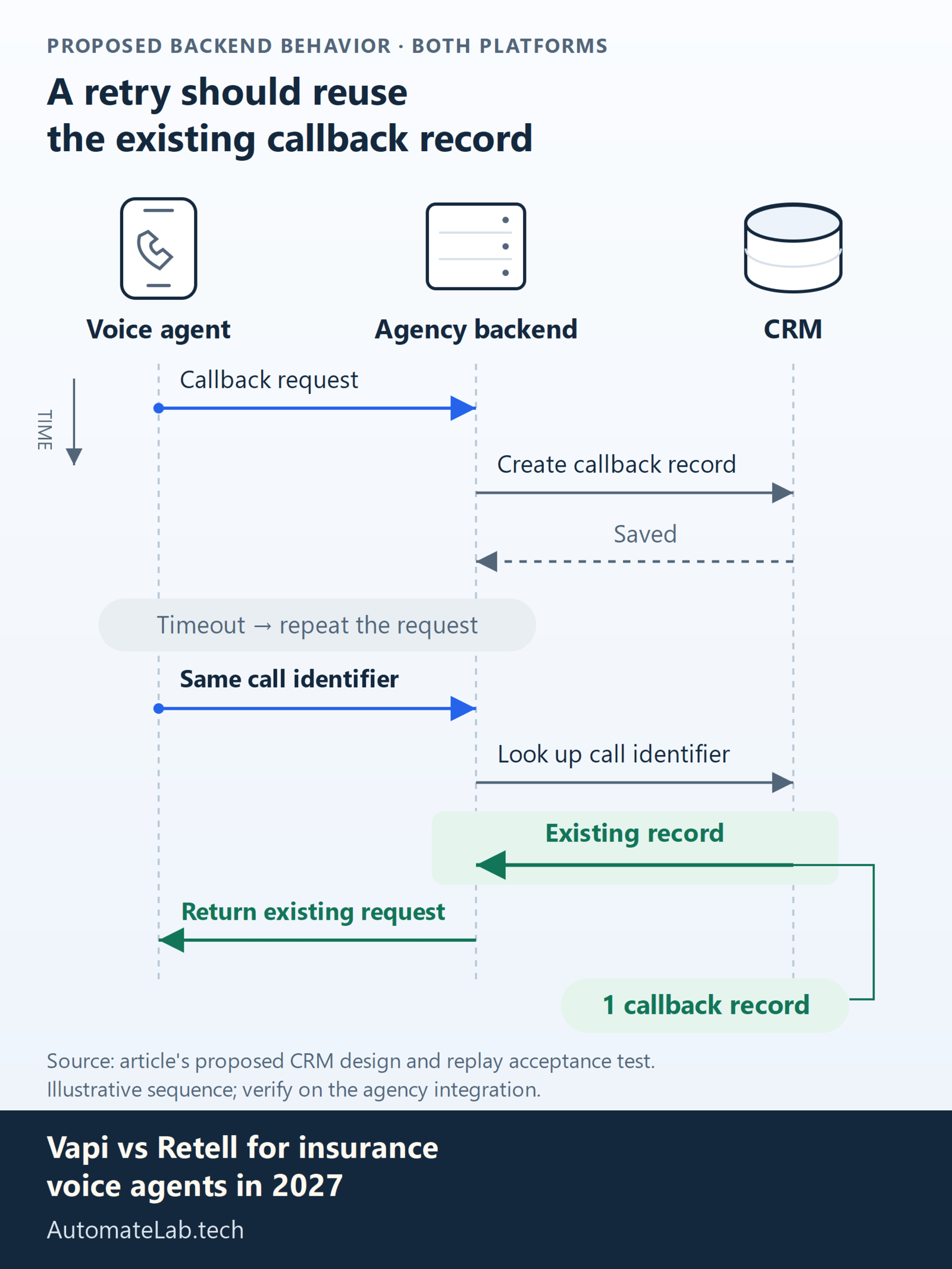
Use a call identifier to make repeat writes safe. If a timeout causes the same callback request to arrive twice, the backend should return the existing request instead of creating a duplicate. Give the agent separate outcomes for saved, rejected, and temporarily unavailable actions so it cannot describe an unsuccessful write as complete.
Retell's concurrency guide puts quotas at workspace level and supports reserved inbound capacity. Vapi's capacity model shares concurrent lines across organizations within a current subscription. Budget for simultaneous callers and outbound traffic, not merely total monthly minutes.
The Vapi pricing page separates hosting, providers, transport, and optional Success Packages. Core is $29/month; extra lines are $10 per line monthly. Retell pricing varies with the voice-agent configuration and paid options. Request matching quotes for the same model, call duration, carrier route, recording policy, and support requirement.
Give the pilot a written escalation boundary. If the caller challenges a record match or asks for advice beyond the approved script, route to a person. Include that conversation in regression checks whenever a prompt or CRM mapping changes.
Related guides cover Build an AI Sales Agent: Tools, Workflow, and Prompts and Best no-code AI agent builders for 2026.
How do you accept an insurance voice-agent pilot?
Use synthetic customer records and an agency-approved script. This is a proposed acceptance test, not a report of tests performed on these services.
- Call the production-style inbound route and confirm the correct CRM record and permitted response.
- Transfer to an available person and verify the destination, spoken context, and actual connection in carrier records.
- Repeat with busy, no-answer, and voicemail destinations and verify the agreed fallback.
- Replay a CRM request after a timeout and confirm one callback record, then repeat a normal successful write.
Run concurrent inbound calls while outbound work consumes capacity. Require an observable outcome for every attempt. Before launch, assign an owner for call alerts and a person authorized to change the routing configuration. Contractual support and service commitments must match the agency's operating hours.
FAQ
Is Retell more reliable than Vapi for insurance calls?
No comparable independent benchmark is established here. Measure completed handoffs and correct CRM outcomes on the same carrier route before choosing.
Does Vapi support warm transfers with every carrier?
Support depends on the transfer mode. Check its provider compatibility table and test the exact destination, including failures.
Can either platform update an insurance CRM?
Both can invoke backend tools. Your integration must control identity checks, allowed writes, and duplicate handling.