
Best voice AI platforms for agencies in 2027
Compare Synthflow, Vapi, and Retell for agency clients: workspace isolation, white-label features, billing, shared capacity, and repeatable onboarding.

TL;DR: Choose Synthflow for a native branded client workspace, Vapi for a custom agency application, or Retell for separately billed client workspaces; compare onboarding and isolation before quoting a per-minute service.
An agency needs to maintain the same service across clients without mixing their credentials or changing every deployment by hand. The platform decision should cover who can see recordings, who pays usage charges, and how a tested workflow reaches the next client. The agency still needs evidence about each of those operating costs.
Which voice AI platform fits a multi-client agency?
These recommendations follow current vendor documentation checked on 26 October 2026. They describe operational fit, not a measured ranking of voice quality. Ask for the exact account structure and commercial entitlements in writing before promising a branded portal to a client.
| Platform | Client structure | Current paid entry | Operational trade-off |
|---|---|---|---|
| Synthflow | Native subaccounts, branding, permissions, reusable products. | Enterprise contracts from $30,000 annually. | Contract must confirm agency features and capacity. |
| Vapi | Organizations under a subscription; build your client application. | Usage hosting $0.05/min plus dependencies; optional Core $29/month. | Current subscription concurrency is shared across organizations. |
| Retell AI | Separate workspaces with separate keys, usage, and billing. | Pay as you go; voice-agent range $0.07-$0.31/min. | Workspace creation is manual; SaaS tenancy needs application controls. |
When should an agency choose Synthflow?
Synthflow's agency settings document a custom domain and branding, subaccount permissions, shared analytics, and products that import agents and workflows into client workspaces. This is the closest match when clients need to sign in to an agency-branded application.
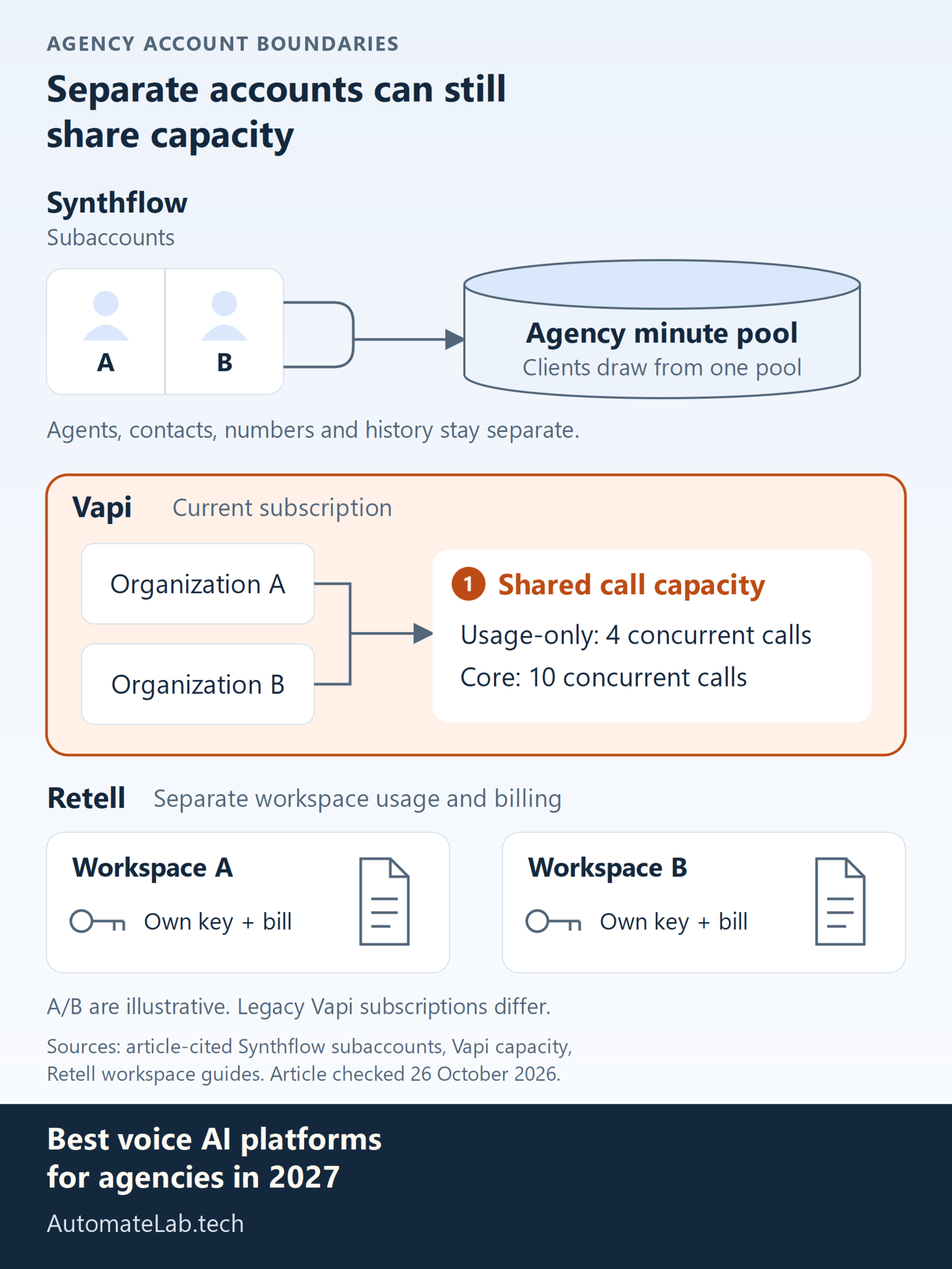
Its subaccount documentation separates agents, contacts, phone numbers, and history while drawing minutes from the agency pool. Defaults cover limits and capabilities. The guide also documents a Subaccounts API. Changing defaults applies to future subaccounts, so audit existing clients separately when changing an allowance.
The commercial hurdle is substantial. Synthflow pricing now starts with enterprise contracts at $30,000 annually, scoped by volume, integrations, security, and support. Older self-serve agency-plan comparisons do not establish what a new buyer can purchase. Have sales confirm which documented partner features belong in your contract.
When should an agency choose Vapi?
Vapi fits an agency that wants to build the client-facing service and control its provider choices. Its organization model separates workspaces under a subscription, but concurrent call lines are shared across that subscription. Another organization does not automatically buy another independent call quota.
The current packages include two organizations on usage-only and Core, with extra organizations at $20/month each. Usage-only includes four concurrent calls; Core includes ten. Model, voice, transcription, and transport selections affect the final bill. A package fee is only one line of the service cost.
Vapi API keys belong to organizations. Private keys can access everything within their organization and must stay server-side. Give the client application its own access checks and maintain separate CRM credentials for each customer. A display filter over one shared dataset is insufficient isolation.
When should an agency choose Retell AI?
Retell workspaces isolate resources, keys, billing, member roles, and webhook settings. One workspace per client is a clear operating model when a client needs its own invoice and access. Adding a payment method in one does not configure the others.
There is no workspace provisioning API in the current documentation. For a multi-tenant SaaS, Retell describes keeping resources in one workspace and tracking tenants in the application. That trades manual onboarding for an application-owned isolation boundary. Decide which model the agency can maintain before adding its tenth client.
Retell's pay-as-you-go offer includes analytics, API access, and simulation testing. Enterprise adds commercial and support options. A solution-partner relationship does not by itself establish a native white-label portal or a private deployment entitlement.
What should be reusable across agency clients?
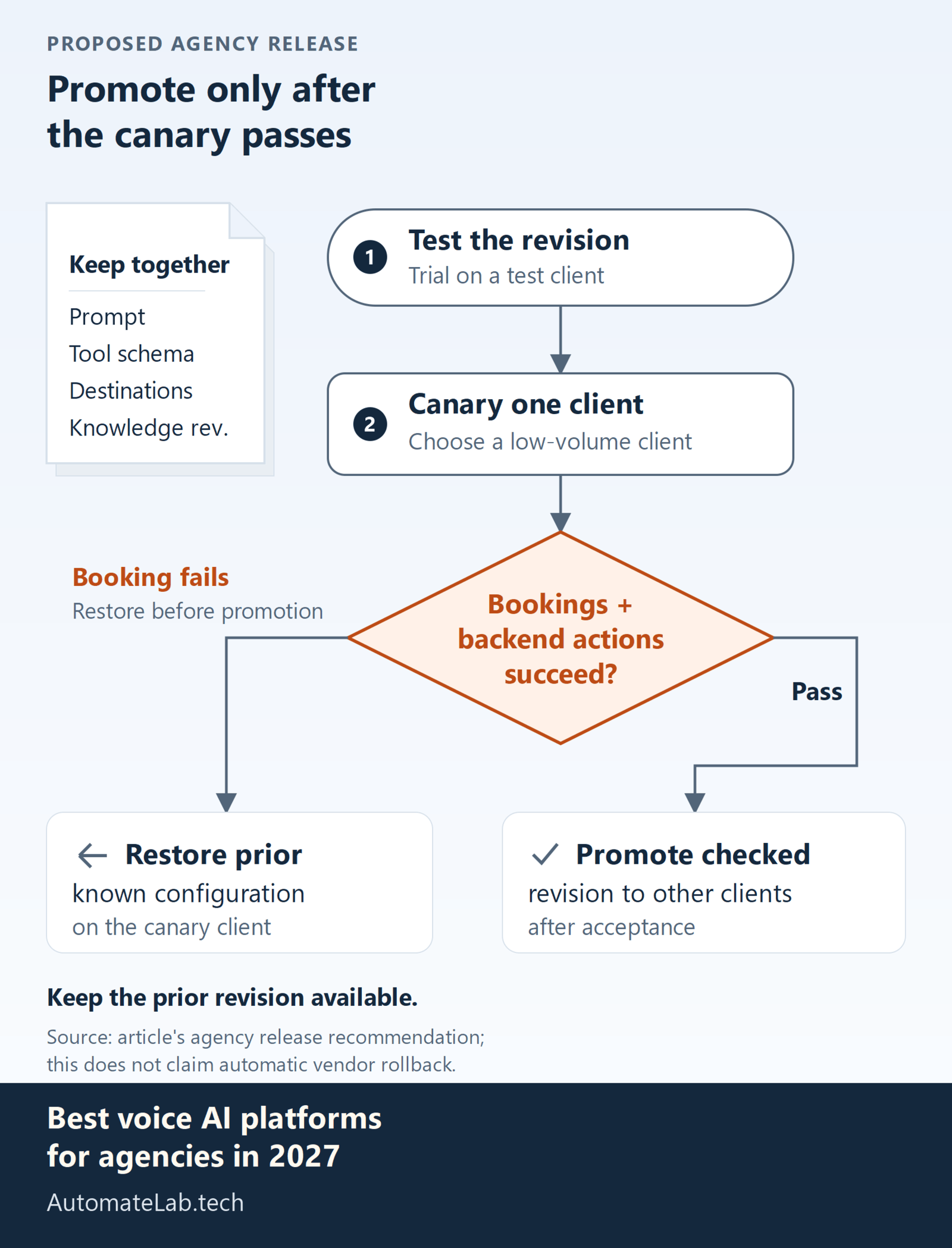
Keep a tested workflow template separate from customer configuration. Store destinations, CRM mappings, and approved knowledge sources per client. Record which template revision each client runs, then trial changes on a test client before promoting them. Copying a prompt without its tool contracts and fallback rules leaves an incomplete deployment.
For a revision rollout, choose one low-volume client as a canary and keep the prior revision available. Record the prompt, tool schema, destination map, and knowledge revision together. If bookings fail after deployment, restore that known configuration before promoting other clients. This release procedure is an agency recommendation, not a claim that each vendor supplies automatic rollback.
Monitor outcomes per client: successful bookings, failed backend actions, and completed human handoffs. Reconcile platform usage with your own client identifiers before generating invoices. Establish who receives the alert when a client's CRM rejects a request and how that client can obtain its call records when the engagement ends.
A workspace is a logical product boundary. It does not establish a privately hosted runtime. If a customer requires private infrastructure, ask the vendor to specify deployment location, administrative access, and supported integrations contractually before the agency accepts the job.
Related guides cover Best no-code AI agent builders for 2026 and Agentic workflow vs RPA cost: a 2026 line-item breakdown.
How do you test client isolation before onboarding?
- Create clients A and B with different synthetic contacts and CRM credentials.
- Run the same workflow in each and prove A cannot retrieve B's contacts or recordings.
- Change a template on a test client and verify an existing production configuration stays correct.
Also revoke A's credential, drive concurrent calls, and reconcile both usage reports. Require the correct tenant on every backend action and a clear failure for revoked access. This is a proposed acceptance test; no vendor production accounts were benchmarked for this comparison.
FAQ
Which platform has native agency white-label features?
Synthflow documents branded domains and client subaccounts. Confirm access and entitlements in the current enterprise agreement.
Do separate Vapi organizations have separate concurrency?
Current subscriptions share concurrent lines across organizations. Legacy subscriptions use a different structure, so check the account's billing model.
Can Retell create a workspace for every customer through an API?
The current workspace guide says provisioning is manual. Automated SaaS onboarding requires a tenancy design within your own application.