
Free AI SEO Checker: 39 AEO and GEO Checks Explained
The free AI SEO checker at automatelab.tech runs 39 AEO and GEO checks on any URL and returns a letter grade with per-check evidence and fix recipes. No signup required.
TL;DR: The free AI SEO checker at automatelab.tech/tools/ai-seo-checker/ runs 39 checks across five categories and returns a letter grade, per-check evidence, and fix recipes with no signup required.
Classic SEO tools tell you whether your title tag is too long. They do not tell you whether GPTBot is blocked in your robots.txt, whether your first paragraph resolves the implied question in under 60 words, or whether your JSON-LD schema type actually matches the content type on the page. Those three things are what answer-engine optimization (AEO) and generative-engine optimization (GEO) check. This post walks through how the tool works, what each category tests, and a worked example.
What is AEO, and how does it differ from GEO and classic SEO?
AI SEO is the umbrella term. AEO (answer-engine optimization) targets featured snippets and voice-assistant answer boxes on traditional search engines. GEO (generative-engine optimization) targets citations inside ChatGPT, Perplexity, Claude, and Google AI Overviews. The AEO and GEO checklist covers the full distinction. In practice all three converge on the same page-level requirements: crawlable by AI bots, answer-extractable structure, schema markup, and E-E-A-T signals.
Classic SEO and AI SEO diverge in three areas: bot access rules (AI crawlers use different user-agent strings than Googlebot), content structure (answer density in the first paragraph matters more than keyword density), and schema markup (JSON-LD types like FAQPage and HowTo are directly parsed by LLM retrieval pipelines, not just used as ranking hints).
How does the free AI SEO checker work?
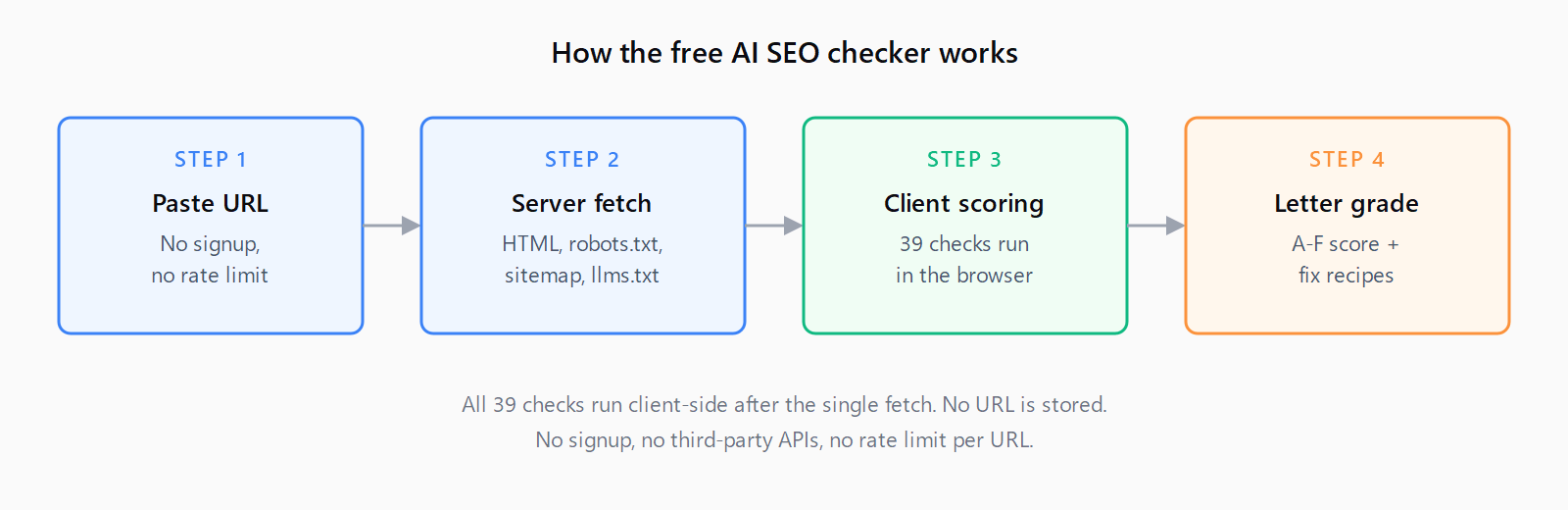
Paste a URL, click Run Audit. A server-side fetch proxy retrieves your page HTML, robots.txt, sitemap, and llms.txt in one round trip. The proxy is SSRF-hardened: it rejects non-http(s) schemes, IP literals, and hostnames that resolve to private or loopback ranges. No URL is stored. After the fetch returns, all 39 checks run client-side in the browser. No third-party API calls, no account, no rate limit per URL.
The scoring formula is weighted: each check carries a weight from 1 (low impact) to 5 (critical). A pass earns full weight, a warn earns half, a fail earns zero. The category score is the weighted percentage of passes. The overall score is the unweighted average of the five category scores, mapped to a letter grade: A for 90 or above, B for 75-89, C for 60-74, D for 40-59, F below 40.
What do the five check categories actually test?
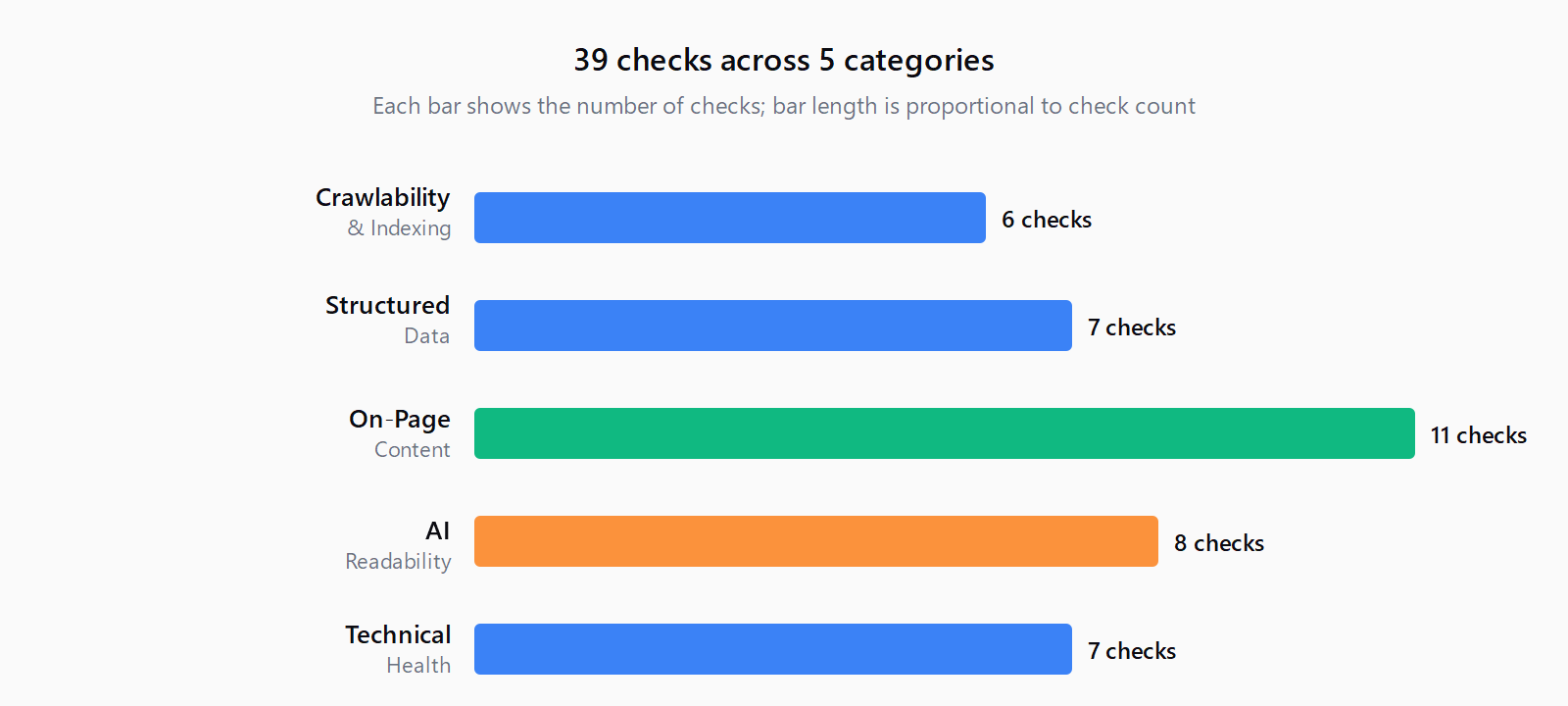
Crawlability and indexing (6 checks)
The first thing any AI search engine does is try to fetch your page. Six checks verify the access path is clean. The two highest-weight checks are AI crawlers allowed (weight 5) and robots meta clean (weight 4). The AI crawlers check parses your robots.txt and verifies that GPTBot, OAI-SearchBot, ClaudeBot, Claude-SearchBot, PerplexityBot, and Amazonbot are not disallowed. The robots-meta check verifies the page itself carries no noindex or nofollow directives. The other four check that robots.txt is reachable, an XML sitemap exists, the canonical URL is self-consistent, and hreflang annotations are present for multi-locale sites.
Structured data (7 checks)
Structured data is the fastest citation lever. JSON-LD lets AI retrieval systems pull entity-typed data without parsing prose. The checker verifies JSON-LD is present (weight 4), that the schema type matches the content (weight 3), and that required properties are populated (weight 3). It also checks OpenGraph, Twitter card, an Article author block with sameAs pointing to a Wikidata or LinkedIn URI, and an Organization logo block. The 13 structural signals AI assistants score covers why the sameAs link matters for E-E-A-T disambiguation.
On-page content (11 checks)
Eleven checks cover the signals that determine whether your prose is extractable. The H2 question shape check (weight 3) counts how many H2 and H3 headings start with a question word or end with a question mark, then checks the ratio against the 30% threshold from the Metronyx study (72% of ChatGPT-cited pages used question-style headings). The reading level check flags paragraphs over 100 words and sentences over 35 words. LLMs quote scannable prose. The nine other checks cover title and meta length, single H1, word count, link presence, title-H1 overlap, heading hierarchy, image alt coverage, and anchor text quality.
AI readability (8 checks)
The two highest-weight checks are answer density (weight 4) and render mode (weight 4). Answer density checks whether the first paragraph above the first H2 resolves the page's implied question in under 60 words. Render mode checks whether the raw HTML contains at least 200 visible words; a client-side React shell is invisible to GPTBot and ClaudeBot because those bots do not execute JavaScript. The other six checks cover llms.txt presence, list and table count, named entities, author and date signals, dateModified freshness, and outbound authority links.
Technical health (7 checks)
HTTPS (weight 3) and mixed content (weight 3) are the highest-weight checks. The others are mobile viewport, HTML payload size and compression, explicit image dimensions, HSTS, and a basic security header set. A page served over HTTP or with mixed content is silently deprioritized by AI Overviews regardless of content quality.
What does a real audit look like?
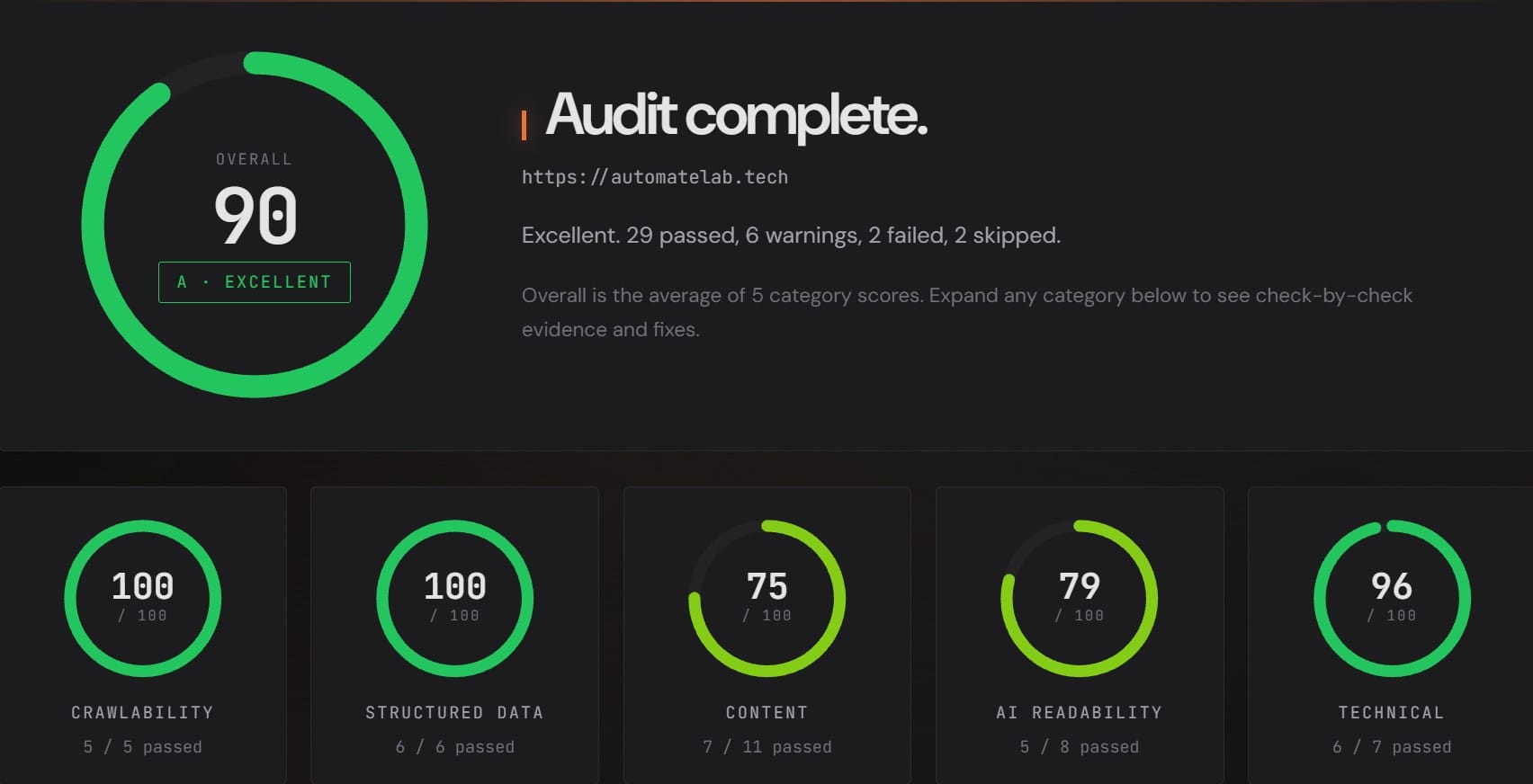
Paste a URL into the checker and results arrive in 10-20 seconds. The score board shows the overall letter grade plus a five-bar gauge per category. Each check then expands to show its status (pass/warn/fail), the evidence string the checker found, and a one-sentence fix. A page blocking GPTBot in robots.txt shows: disallowed: GPTBot (robots.txt line 4) with a fix to allow training traffic or scope it to specific paths. A page with no JSON-LD shows the structured data category near zero with evidence: 0 JSON-LD blocks found.
How does this compare to paid AI SEO tools?
Most AI SEO audit tools in 2026 cost $50 to $200 per month and require a Google Search Console connection. This checker has no signup and no stored data: all 39 checks run client-side after a single server-side fetch. The trade-off is one URL at a time with no bulk export. For site-wide batch audits, use the @automatelab/ai-seo-mcp package.
What about the @automatelab/ai-seo-mcp for Claude Code and Cursor users?
The AI-SEO MCP (v0.5.0, published to npm as @automatelab/ai-seo-mcp) ships 14 tools covering the same checks plus rewrite suggestions and batch sitemap audits. It runs inside Claude Code, Cursor, and any MCP-compatible agent host with no API key. Useful when you want to lint pages in a CI pipeline or batch-audit a sitemap from the command line. The browser tool is the fastest path for a single-URL spot check; the MCP is for repeated or automated audits inside a development workflow.
Run the audit on your page
The checker is free, no signup, no extension. Open the AI SEO checker, paste a URL, and see your AEO and GEO readiness score in under 30 seconds.
FAQ
What is the difference between AEO and GEO?
AEO (answer-engine optimization) targets answer boxes, featured snippets, and voice-assistant responses on traditional search engines. GEO (generative-engine optimization) targets citations inside ChatGPT, Perplexity, Claude, and similar LLM-powered systems. In practice they share most requirements: structured data, answer-extractable headings, and clean crawler access. The free AI SEO checker tests both.
Why does the checker run client-side instead of on a server?
A single server-side fetch proxy retrieves the raw HTML, robots.txt, sitemap, and llms.txt. All 39 scoring checks then execute in your browser. This eliminates API keys, rate limits, and any requirement to store your URL or audit results. The proxy is SSRF-hardened and applies a per-IP token-bucket rate limit.
Does the checker test whether ChatGPT actually cites my page?
No. It tests the structural, technical, and content signals that correlate with citation eligibility. Whether a specific query returns your page as a source depends on query intent, retrieval system selection, and competition, none of which a single-page audit can predict. For live citation monitoring, the Citation Intelligence MCP covers that use case.
Which AI crawlers does the tool check for in robots.txt?
The checker looks for GPTBot, OAI-SearchBot, ClaudeBot, Claude-SearchBot, PerplexityBot, and Amazonbot. A block on any of these fires a fail on the AI crawlers check (weight 5, the highest-weighted check in the tool).
What is the fastest fix for a low AI readability score?
The two highest-weight checks in the AI readability category are answer density and render mode. If the page is server-rendered and already passes render mode, the answer density fix is fastest: rewrite the opening paragraph so the first 40-60 words directly resolve the page's implied question, then move context and caveats below the first H2.
Can I use the checker from Claude Code or Cursor?
Yes. Install @automatelab/ai-seo-mcp v0.5.0 and add it to your MCP config. The package gives Claude Code and Cursor 14 audit tools, including the same checks as the browser tool plus rewrite suggestions and batch sitemap auditing. No API key needed.