
Agentic Workflow vs RPA: Which Makes Business Sense in 2026
RPA for structured, stable work; agentic workflows for judgment on messy inputs. When each makes business sense, why hybrids win, and how to dodge the 40% failure rate.
TL;DR: Use RPA for stable, structured, high-volume tasks and agentic workflows for variable, unstructured work that needs judgment, and expect to run both - a hybrid where bots execute and agents decide is the pragmatic 2026 answer.
The pitch in 2026 is that agentic AI makes RPA obsolete. The reality is more boring and more useful: they are good at different things, picking the wrong one costs you twice, and Gartner expects a large share of agentic projects to fail outright. Here is how the two actually differ, when each makes business sense, and why most serious deployments use both.
What is the difference between RPA and agentic workflows?
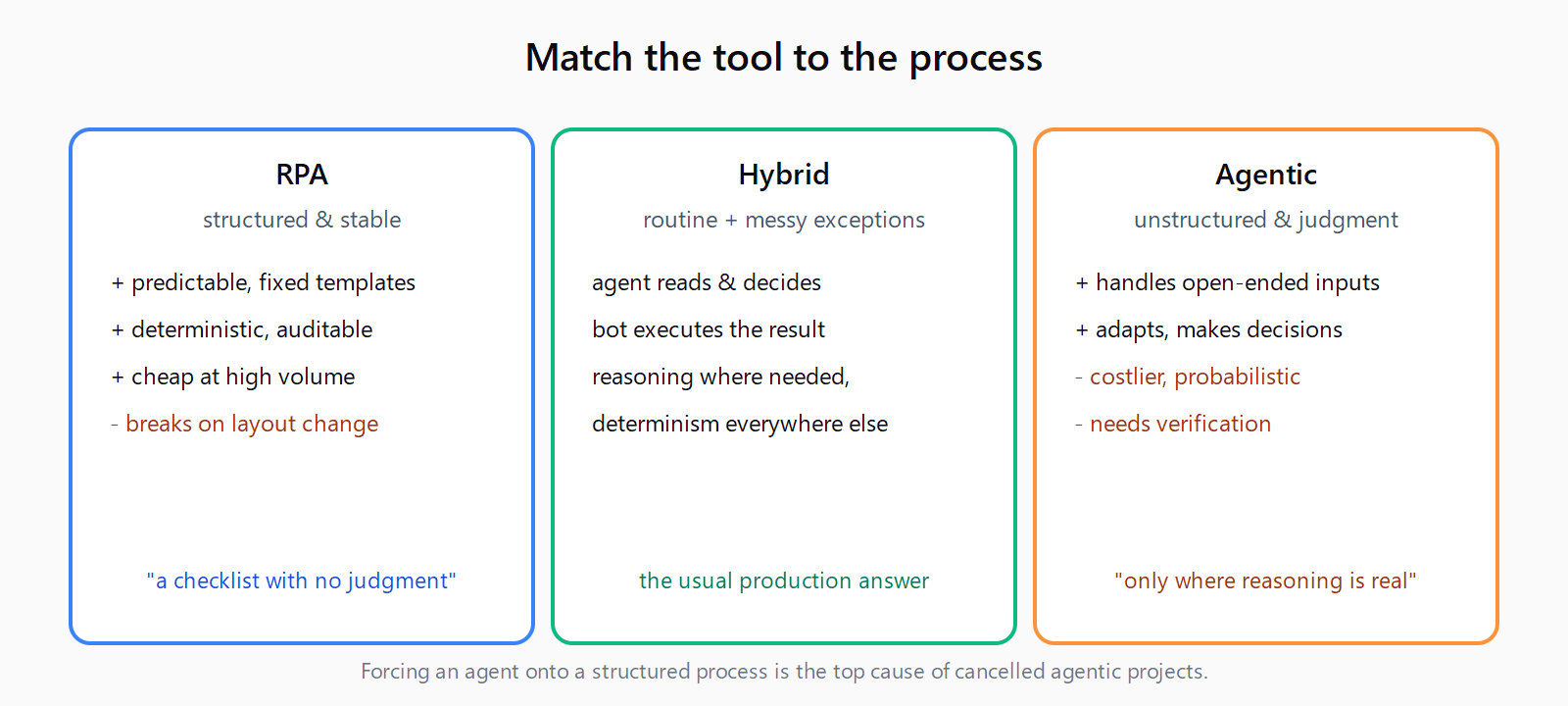
RPA bots follow rules; agents reason. An RPA bot walks a fixed, deterministic path - click here, copy that field, paste it there - and does it identically every time. It is fast, cheap per run, and completely predictable, which is exactly why it breaks the moment a screen layout or file format changes. An agentic workflow pursues a goal through probabilistic reasoning: it interprets context, adapts to inputs it has not seen before, and decides what to do next rather than replaying a script. That flexibility is its strength and its risk - it handles the messy work RPA never could, but its output is not guaranteed to be identical or correct every time.
When does RPA make business sense?
RPA is the right tool when the process is predictable, structured, and rarely changes: keying invoices from a fixed template, moving records between two systems on a schedule, reconciling fields that always live in the same place. In those cases determinism is a feature - you want the same result every time, an auditable trail, and no surprise reasoning. RPA tools like Power Automate are cheap to run at volume and easy to reason about in a compliance review. If a junior employee could do the task by following a checklist with no judgment calls, RPA will do it faster and without complaint.
When does an agentic workflow make business sense?
Agentic workflows earn their keep when the work involves unstructured inputs or genuine decisions: triaging a free-text support ticket, extracting data from documents that vary wildly in layout, or handling the exceptions that a rule-based bot kicks out. These are tasks where writing an exhaustive rule set is impossible because the inputs are open-ended. An agent can read context, call tools - which is how agents reach external tools and systems - and choose an action, which is precisely what RPA cannot do. The cost is variability: you trade guaranteed repeatability for the ability to handle the long tail, and you take on a verification and risk-control burden that RPA does not carry.
Why do so many agentic projects fail?
This is the part the hype skips. Gartner projects that over 40% of agentic AI projects will be cancelled by the end of 2027, citing cost overruns, unclear value, and weak risk controls. The pattern is teams reaching for an agent because it is the exciting option, on a process that was structured enough for RPA all along - paying LLM inference costs and accepting probabilistic output to do a job a deterministic bot did more cheaply and reliably. Agentic automation is powerful where reasoning is genuinely required; it is an expensive liability where it is not. The failures are usually a tooling mismatch, not a technology failure.
How do RPA and agentic workflows compare?
| Dimension | RPA | Agentic workflow |
|---|---|---|
| Behaviour | Deterministic, rule-based | Probabilistic, goal-seeking |
| Best inputs | Structured, predictable | Unstructured, variable |
| Output | Identical every run | Adapts; needs verification |
| Cost per run | Low, fixed | Higher, LLM inference |
| Breaks when | UI or format changes | Task is ambiguous or unguarded |
| Best for | High-volume routine work | Decisions and exceptions |
Why is a hybrid usually the answer?
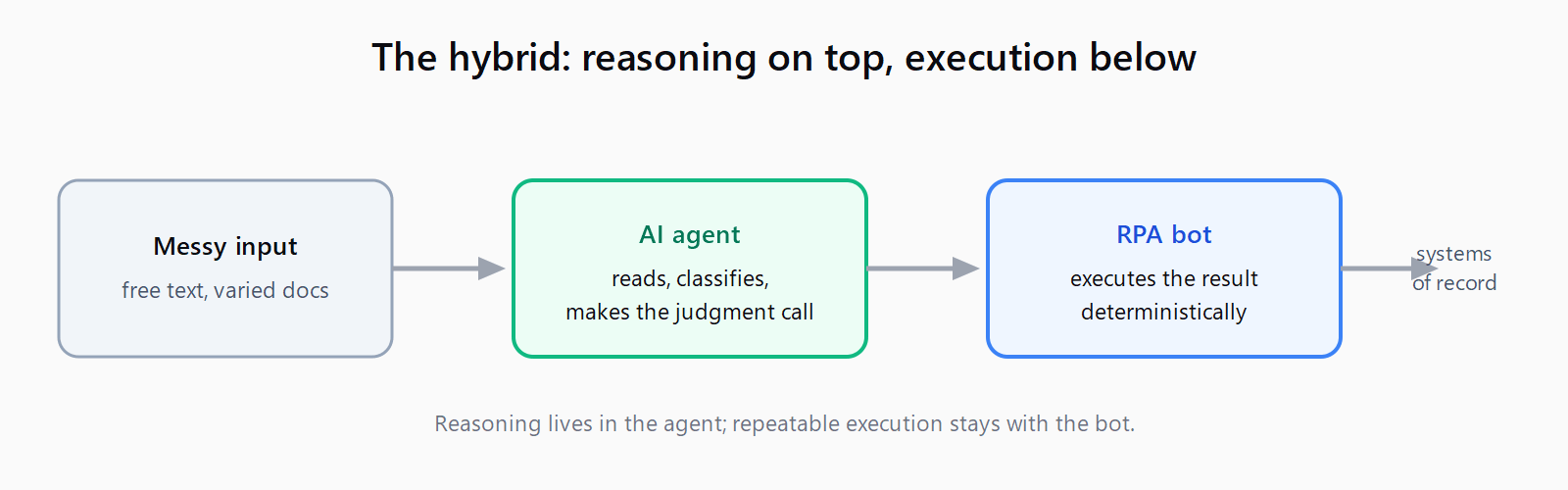
Most successful deployments do not choose - they layer. RPA bots handle the repetitive, structured execution, and agents sit on top to manage exceptions, interpret unstructured inputs, and make the calls that need judgment. The question the strongest teams ask is not "agent or bot" but "where should reasoning live, and where should execution remain." A claims process might use an agent to read and classify a messy submission, then hand the structured result to an RPA bot that updates the systems of record deterministically. You can wire custom AI agents into that seam where the decision happens and leave the plumbing to bots.
How do you avoid becoming part of the failed 40%?
The projects that fail tend to skip the unglamorous step of scoping. Before committing to an agent, write down what the process actually requires: how often the inputs vary, whether a wrong output is recoverable, and what a human would need to check. If the honest answer is "the inputs are the same every time and a wrong result is expensive," that is an RPA job, and an agent will burn money proving it. Where an agent is warranted, put guardrails around it from day one - a verification step, a confidence threshold that routes uncertain cases to a person, and a hard cap on what it can act on without review. Start with one process, measure the cost and error rate against the RPA baseline, and expand only when the numbers justify it. Most cancellations trace back to skipping that baseline.
How do you decide in three questions?
- Is the process structured and stable? If yes, RPA is cheaper and safer - do not reach for an agent.
- Does it need judgment on unstructured or variable inputs? If yes, an agentic workflow earns its cost.
- Is it mostly routine with a messy exception path? Use a hybrid - bots execute, an agent handles the exceptions.
FAQ
Is agentic AI replacing RPA?
Not wholesale. Agentic AI handles work RPA never could, but RPA remains cheaper and more reliable for structured, high-volume tasks. Most organizations run both rather than replacing one with the other.
Is RPA obsolete in 2026?
No. For predictable, rule-based processes, RPA is still the cheaper and more auditable choice. It only looks obsolete when it is forced onto unstructured work it was never designed for.
Why do agentic AI projects get cancelled?
Gartner attributes the projected cancellations to cost overruns, unclear value, and weak risk controls - often because an agent was used on a process that RPA could have handled deterministically and more cheaply.
Can RPA and AI agents work together?
Yes, and it is the most common successful pattern. Agents interpret unstructured inputs and make decisions, then hand structured results to RPA bots that execute deterministically.
Which is cheaper, RPA or agentic automation?
RPA is cheaper per run with fixed, predictable costs. Agentic workflows carry LLM inference costs and a verification burden, so they only pay off when reasoning is genuinely required.