
n8n MCP servers in 2026: the field is a two-horse race
Two n8n MCP servers now dominate the field: one for building workflows, one for debugging. Here is how they compare.
TL;DR: Two n8n MCP servers dominate in 2026 - czlonkowski/n8n-mcp for building workflows (1,851 nodes documented) and automatelab/n8n-mcp for debugging and production validation - and they complement rather than replace each other.
Search for "n8n MCP server" today and you quickly land on two serious options. The rest are forks, demos, or unmaintained experiments. Both are open-source, both support Claude Code, Claude Desktop, and Cursor, and both target the same problem: letting an AI assistant work competently with n8n workflows. But they solve different parts of that problem, and the question is not which one to pick but how each fits into your stack.
What does each n8n MCP server do?
The two servers focus on opposite ends of the workflow lifecycle.
czlonkowski/n8n-mcp is a reference database for the n8n node ecosystem. It documents 1,851 nodes (822 core plus 1,029 community), covering 99% of node properties and 63.6% of specific operations. Its primary tool is node lookup: give the AI a task in natural language and the server returns the correct node name, required fields, and a starter JSON block. It also generates complete multi-node workflows from scratch, with self-correction when the initial draft fails. The server requires a live n8n instance for its most powerful features.
automatelab/n8n-mcp focuses on the phase after the workflow exists: making it run correctly and not silently discard data. Its nine tools split into four that operate offline (on exported JSON) and five that talk to a live instance. The signature tool is n8n_explain_execution, which analyzes a failed or empty-output run and pinpoints exactly where items were lost - the most common source of undiagnosed n8n failures. It also lints workflows for deprecated nodes, missing AI model configurations, and structural issues before they become runtime surprises.
How do they compare on key dimensions?
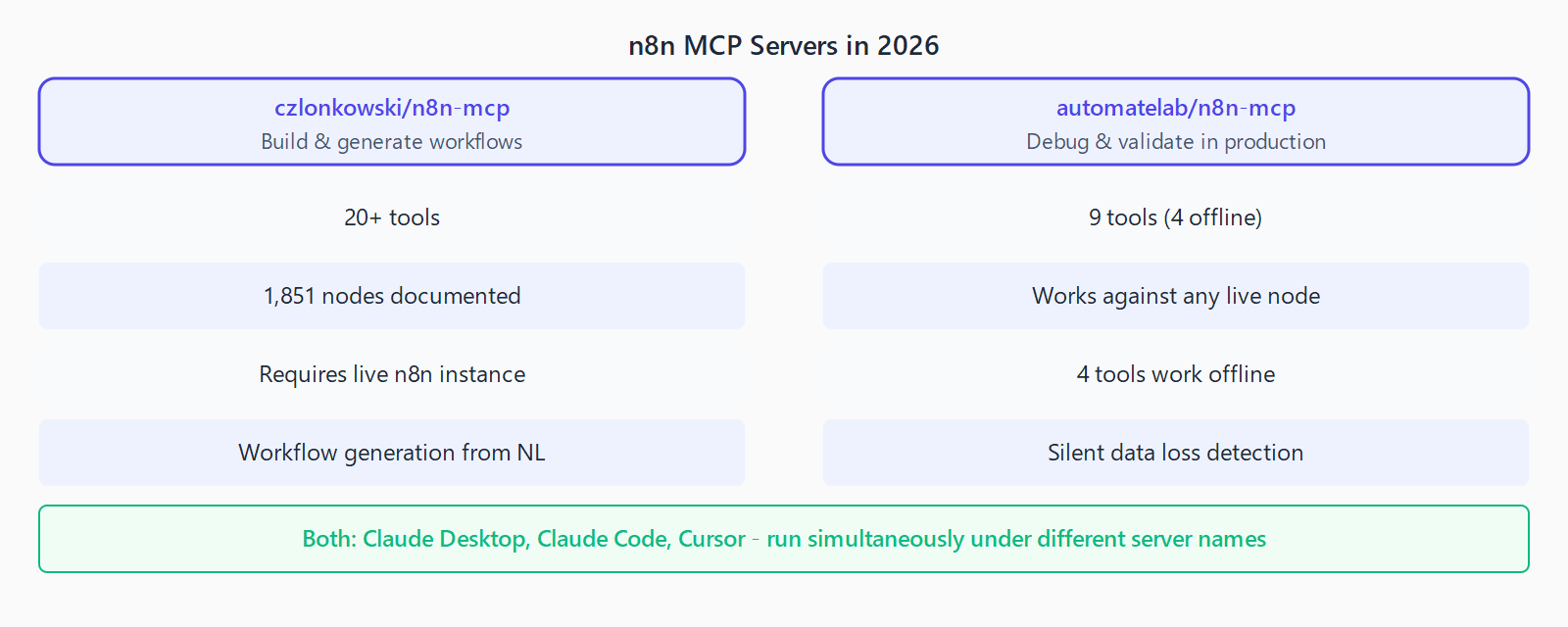
The table below summarizes the practical differences across the criteria that matter for most teams:
| Dimension | czlonkowski/n8n-mcp | automatelab/n8n-mcp |
|---|---|---|
| Primary use | Build and generate workflows | Debug and validate workflows |
| Node coverage | 1,851 nodes documented | Works against any live node |
| Offline capable | Partial (node lookup only) | Yes (4 of 9 tools stateless) |
| Live instance needed | For full workflow generation | For execution analysis tools |
| Transport | SSE (legacy) + HTTP Streamable | HTTP, lightweight |
| Tool count | 20+ tools | 9 tools |
| Best for | Architects, new workflow creation | Debuggers, production validation |
When should you use czlonkowski/n8n-mcp?
This server fits tasks where you are starting from a blank canvas. If you can describe a workflow in plain English - "create a Zap that watches a Gmail label, extracts the data with a Code node, posts a Slack message, and writes a row to Google Sheets" - czlonkowski/n8n-mcp returns a complete JSON workflow that you can import and test. The 1,851-node documentation means the AI rarely invents non-existent node parameters, the most common failure mode when prompting against a model with no n8n training data.
It is also the right choice if you are building a tool or agent that needs to programmatically generate n8n workflows at scale - the server is designed for automation-on-automation use cases.
One limitation: the 63.6% operation coverage means certain node operations are not yet fully documented. For newer community nodes, the AI may still hallucinate parameters. Always test generated workflows before connecting them to production data.
When should you use automatelab/n8n-mcp?
This server fits the scenario every n8n user eventually hits: a workflow runs, produces no output, and no error message explains why. n8n's silent item filtering - IF nodes that match nothing, Set nodes that overwrite with blanks, loop nodes that exit on the first iteration - is notoriously hard to diagnose without reading the execution log line by line. The n8n_explain_execution tool takes the execution ID and walks the AI through each node's input and output counts, flagging exactly where items disappeared.
The offline tools (workflow linter, node scaffolder, JSON validator) require no live connection, making them useful in CI pipelines and pre-deployment review. The full setup guide covers both configuration paths.
Should you run both at the same time?
Yes. They do not conflict, they are not competing for the same slot in your AI config, and they cover the full lifecycle. Use czlonkowski to architect and generate; use automatelab to lint and diagnose. Most Claude Code or Claude Desktop setups can register both under different server names with no friction - n8n-builder and n8n-debugger is a natural pair.
The two servers together are also what distinguishes the n8n MCP ecosystem from single-purpose integrations. For context on what the broader n8n node catalog looks like, the n8n nodes catalog lists every built-in and community node with version and operation details.
FAQ
Do both servers work with Claude Desktop, Claude Code, and Cursor?
Yes. Both use standard MCP transport protocols (HTTP and SSE) that are supported by all major clients. Register each under a distinct server name in your config file to run them simultaneously.
Does czlonkowski/n8n-mcp require a live n8n instance?
For full workflow generation, yes - it calls your instance to validate node availability and test outputs. Four of its tools work offline against the bundled node documentation, but the generation and execution tools require a reachable n8n URL and API key.
Is automatelab/n8n-mcp free?
Yes, it is open-source under the MIT licence. The four stateless tools (linter, validator, scaffolder, documentation) work without any credentials. The five live-instance tools require a self-hosted or cloud n8n instance with an API key.
Which server handles n8n AI Agent nodes better?
They handle different aspects: czlonkowski documents the AI Agent node parameters so the AI can scaffold the node correctly; automatelab's linter checks that the AI Agent node has a model sub-node connected and that the model supports streaming if streaming mode is on - both are common misconfiguration patterns.
Are there other n8n MCP servers worth considering?
A handful of forks and experiments exist on GitHub, but none with consistent maintenance or comparable node coverage as of 2026. The two servers covered here are the only ones with active issue tracking, published changelogs, and documented tool sets.