
Zapier and monday.com Webhooks Return 500 Error After monday's Federated API Migration: How to Fix It
Why a working Zapier-to-monday.com webhook suddenly starts throwing 500 errors, the header that fixes it, and why that fix isn't permanent.
TL;DR: Zapier webhooks to monday.com return 500 or 502 errors because monday.com's API silently rides an auto-advancing "Current" version when no API-Version header is sent; fix it by adding an explicit API-Version: 2024-07 header to the webhook request.
The Zap worked for months, nothing in the workflow changed, and then every run to monday.com started failing with a server error. That's the signature of this bug: it's not something you broke, it's monday.com's API version pointer moving underneath a request that never pinned a version.
Why does the Zapier monday.com webhook return a 500 error?
monday.com migrated its webhook API to a Federated API architecture. Per a 21-reply thread on the Zapier Community, monday.com support attributed the failures to requests "implicitly using the 2024-10 API version" - meaning the request never sent an API-Version header at all.
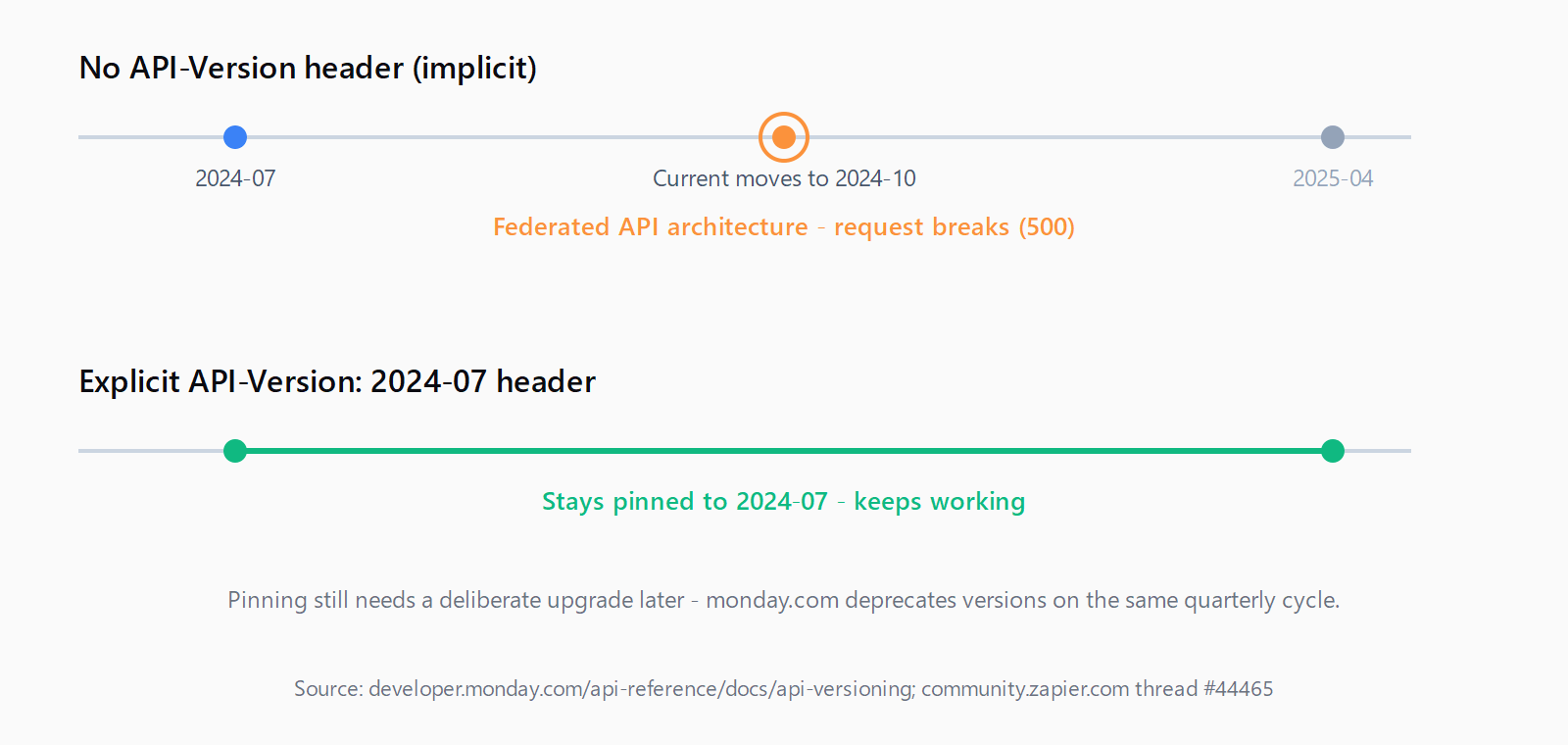
monday's own API versioning documentation explains why that matters: the platform ships quarterly versions named by year and month (2024-07, 2024-10, 2025-04, and so on), selected by sending the version name in an API-Version header. Skip the header, and the request targets "Current" - a pointer that advances every quarter. A webhook built before the Federated API rollout and never updated to pin a version rode "Current" straight into the new architecture and broke.
How do you fix the Zapier monday.com 500 error?
- Open the failing webhook step in Zapier. Find the Webhooks by Zapier action (or the custom monday.com request) that's throwing the 500/502.
- Re-test the Zap. Run the step manually and confirm a 200 response instead of 500/502.
- Use GET for read requests. If the failing step is retrieving data rather than writing it, confirm the HTTP method is GET, not POST - a couple of reports in the thread traced their 500s to a mismatched method on top of the missing header.
Add an explicit header. Set API-Version to 2024-07 - the version confirmed working by multiple users in the community thread:
API-Version: 2024-07
Content-Type: application/json
Is pinning to 2024-07 a permanent fix?
No - and this is the part the community thread doesn't spell out. Pinning to 2024-07 stops today's failure, but 2024-07 is itself a dated version that monday.com will eventually deprecate on the same quarterly cycle that produced this bug. The durable fix isn't "always use 2024-07," it's "always send an explicit API-Version header for whichever version you've actually tested against," so the request never silently rides "Current" into a future breaking change again. Check monday's changelog periodically and move the pinned version forward deliberately, on your own schedule.
How do you verify the fix worked?
After adding the header, run the Zap's webhook step manually in the Zapier editor and check the response code is 200. If you're debugging outside Zapier's UI, replay the same request with curl and the header attached, and confirm the response's own API-Version field echoes back 2024-07 instead of erroring.
What if the header doesn't fix it?
Two other causes show up in the same thread and in a separate "Monday.com API - 500 Error" report on the Zapier Community: a custom Content-Type header that doesn't match the actual payload format, and using POST for a request that monday.com's Federated API now expects as GET. Check the request method and headers together, not just the version pin - Zapier's per-step payload limits are a separate failure mode worth ruling out too if the error message mentions size rather than a version or method. For the wider set of vendor webhook payload shapes and trigger conditions, automatelab's catalog of vendor webhook events covers what a healthy monday.com payload looks like alongside 29 other vendors.
If none of that applies, check the Automation Error Index for other Zapier and monday.com entries, or the community thread's more recent replies for whether monday.com has shipped a further change.
FAQ
Why did my Zapier-to-monday.com webhook suddenly start failing with a 500 error?
monday.com migrated its webhook API to a Federated API architecture. Requests that never specified an API-Version header were silently tracking monday's advancing "Current" version, and broke when Current moved into the new architecture at 2024-10.
What is monday.com's Federated API migration?
It's an internal architecture change to how monday.com serves its Platform API, applied as part of the 2024-10 quarterly API version. It's not documented as a breaking change for integrations that pin an explicit version, only for requests that omit the API-Version header.
Does adding the API-Version: 2024-07 header permanently fix the error?
It fixes it today. Since 2024-07 is a dated version monday.com will eventually deprecate on its normal quarterly cycle, the durable habit is to always send an explicit, deliberately-chosen version header rather than relying on a specific hardcoded date forever.
How do I know which monday.com API version my Zapier webhook is using?
Check the response headers from a manual test run - monday.com echoes the version it used in its own API-Version response header. If your request never set one, it was on whatever "Current" resolved to at request time.
Is this a Zapier bug or a monday.com change?
It's a monday.com API change (the Federated API migration and its quarterly version advancement), not a Zapier defect. The fix happens on the request side - adding the header - not by waiting for a Zapier patch.