
Agentic workflow vs RPA cost: a 2026 line-item breakdown
RPA or agentic workflow — which is actually cheaper? A worked 24-month cost model across licensing, build, maintenance, and exception handling shows where each model wins and where token spend flips the equation.
TL;DR: RPA costs less upfront for stable, rule-heavy processes -- but mature deployments spend 30-50% of their budget on maintenance, and that overhead flips the 24-month TCO comparison for any process that changes frequently or generates exceptions above 3%.
Buyers comparing agentic workflows to RPA almost always anchor on licensing. That's the wrong number. The real question is: what does each model cost across a 24-month lifecycle once you add build time, maintenance, exception handling, and scaling overhead? Those four line items routinely invert the intuition from vendor pricing pages -- and the cheaper option depends entirely on how often your process changes.
What does RPA actually cost?
UiPath's published pricing starts at $25/month for the Basic tier (two unattended robots, five users). Standard and Enterprise tiers require a sales call, which at enterprise volume typically lands in the four-to-six-figure annual range. But licensing is rarely the dominant cost in a mature deployment.
The four line items that determine RPA's actual TCO:
- Licensing. Per-bot or per-process pricing from UiPath, Automation Anywhere, or Power Automate. Ranges from $200/month for a single attended bot to $2,000+/month per unattended process bot at enterprise tier, before volume discounts. Power Automate Process license runs around $215/month for a single unattended flow.
- Build cost. RPA bots are rule-based, meaning every conditional branch and exception path must be explicitly coded. A mid-complexity process -- invoice ingestion with field validation, say -- typically runs two to four weeks of developer or RPA-specialist time: $8,000-$20,000 depending on market rate.
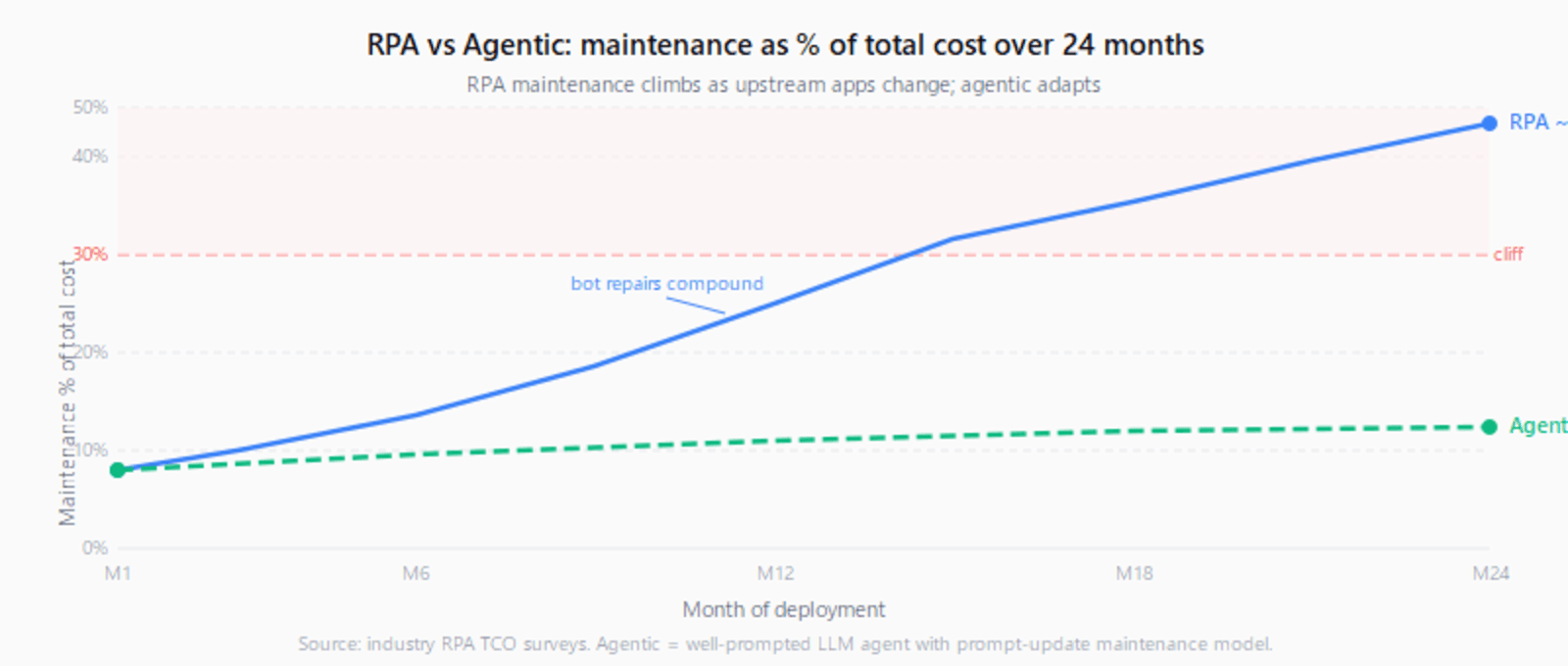
- Maintenance. This is the figure most comparisons bury. When an upstream application changes its UI -- a button moves, a field label changes, a portal upgrades -- bots break silently. Industry analyses consistently report 30-50% of total RPA program spend going to maintenance and troubleshooting. For a team spending $5,000/month on licenses and developers, that is $1,500-$2,500/month in hidden labor before anyone notices the queue has stalled.
- Exception handling. RPA does not think. Every edge case outside the coded rules routes to a human review queue. At scale, exception rates of 3-10% are common. At 1,000 daily runs with a 5% exception rate, 50 items per day require a human to touch them.
What does an agentic workflow cost?
Agentic automation replaces the rule tree with an LLM that interprets instructions and adapts to context. The cost structure differs in every line item:
- Build cost. Agentic workflows require less explicit rule-coding for complex, variable processes. A mid-complexity invoice extraction agent using a framework like LangGraph or a hosted platform can be built in one to two weeks -- $5,000-$12,000 -- because the model handles branching logic. For simple, stable processes this advantage shrinks: a deterministic task that RPA already handles cleanly does not benefit from agent flexibility.
- Token cost. This is the line item RPA comparisons omit entirely. Every agent invocation calls an LLM API. At mid-volume (hundreds of runs per day), token spend is modest -- $50-$200/month for most workflows. At high volume (thousands of runs per day), it becomes the dominant cost. A workflow averaging 3,000 input and output tokens per run at $0.005/1,000 tokens costs $0.015 per run, or $450/month at 1,000 daily runs. At GPT-4o rates ($0.02/run for the same token count), the same volume reaches $600/month.
- Infrastructure and ops. Self-hosted agent stacks require server hosting, monitoring, and on-call coverage. Managed orchestration platforms add $100-$500/month but remove the ops burden. Cloud-hosted agent services roll this into per-execution pricing.
- Maintenance. Agents adapt to minor UI and schema changes without recoding. When a vendor changes an API field name or reorders a dropdown, a well-prompted agent typically handles it without intervention. Maintenance overhead drops to roughly 5-15% of total cost -- a structural advantage over RPA for any process where the upstream environment changes more than twice a year.
Where does RPA's total cost break down over time?
The 30-50% maintenance figure deserves more attention than it gets. It is not a prediction -- it is what organizations report after deploying RPA at scale. A mid-sized insurance company that deployed 50 bots with an expected 80% efficiency gain found, within six months, that 20% of their capacity was consumed by bot repairs from UI changes and policy updates. The upfront costs were low; the ongoing maintenance overhead ate the ROI.
The structural cause is brittleness. RPA bots depend on element selectors tied to specific application states -- XPath expressions, pixel coordinates, CSS selectors. Any upstream change (a portal redesign, a vendor update, a Windows security patch that shifts window sizing) breaks selectors. The bot either errors out visibly or, worse, continues processing on stale selectors and writes corrupt data to downstream systems.
Agentic workflows shift the breakage model. An agent instructed to "extract the invoice total from the vendor portal" will re-attempt with different strategies if the expected element is not found. It will not always succeed -- novel UI changes can still require a prompt update -- but the failure mode is explicit (the agent reports that it cannot complete the task) rather than silent data corruption that surfaces days later in an audit.
What is the hidden token-cost risk in agentic systems at scale?
The maintenance cliff cuts against RPA. Token cost is the equivalent risk for agentic systems -- and most comparisons omit it.
Token costs are predictable at low volume and can surprise at high volume. If a process scales from 1,000 to 10,000 runs per day, token spend scales linearly -- from $450/month to $4,500/month at the rates above. RPA licensing does not scale linearly (you pay per bot, not per run), so at very high volume, RPA's fixed cost structure becomes an advantage again for the licensing line item alone.
Three mitigations reduce token exposure:
- Use smaller models for deterministic sub-tasks. Routing, classification, and structured field extraction do not require a frontier model. A 7B open-source model self-hosted on a $50/month VPS can handle extraction at near-zero per-run cost. Reserve frontier models for the reasoning steps that actually require them.
- Cache repeated prompts. If your agent uses the same system prompt on every run (which it usually does), prompt caching -- available in both Anthropic and OpenAI APIs -- cuts input-token cost by 50-90% for the cached prefix. For a 2,000-token system prompt at 30,000 runs/month, caching saves $60-$180/month at current rates.
- Set hard token budgets per run. Most orchestration frameworks support max-token limits per agent call. Cap your agent's context window to what the task requires -- uncapped tool-call chains balloon each run's token count without improving output quality.
What does the TCO look like at 1,000 runs per day?
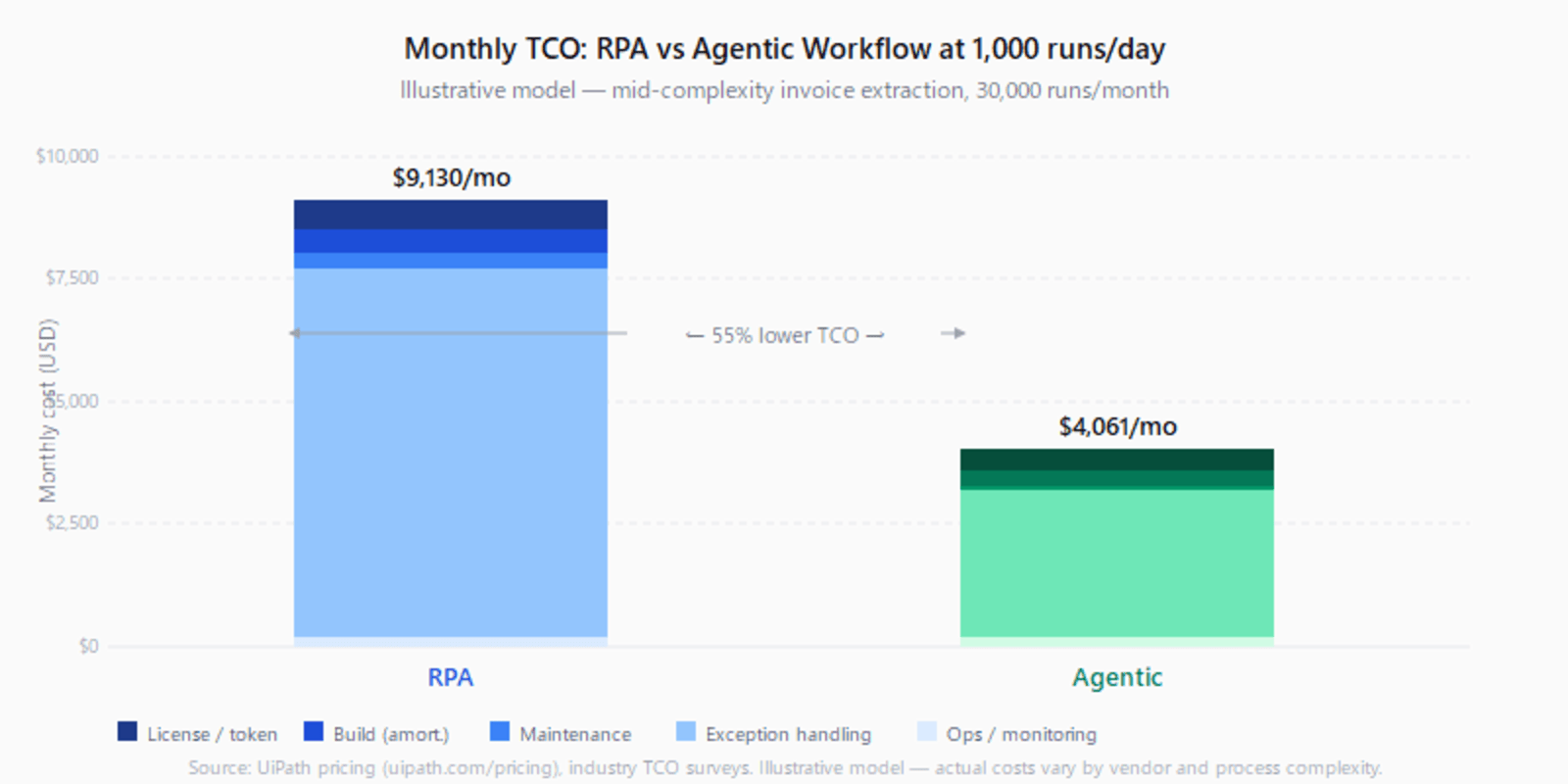
The table below models a mid-complexity invoice extraction process at 1,000 runs per day (30,000 runs/month). Assumptions: $100/hour blended developer rate; RPA build at three weeks, agent build at two weeks; UiPath Standard estimated at $600/month for two unattended bots; LLM at $0.015/run; exception rate 5% for RPA (industry average), 2% for agentic; $5 labor cost per exception resolved; 24-month amortization on build cost.
| Line item | RPA (monthly) | Agentic (monthly) |
|---|---|---|
| License / token cost | $600 | $450 |
| Build (amortized 24 mo) | $500 | $333 |
| Maintenance labor | $330 (30% of license + build) | $78 (10% of license + build) |
| Exception handling | $7,500 (5% × 30k runs × $5) | $3,000 (2% × 30k runs × $5) |
| Ops / monitoring | $200 | $200 |
| Total monthly TCO | $9,130 | $4,061 |
The same methodology — modeling license, build, maintenance, and exception costs over 24 months — applies to low-code-to-low-code decisions too; see the Make vs Zapier 12-month cost model for a parallel analysis. The exception-handling line is the swing factor. If your RPA deployment covers a tightly-controlled process with a 1% exception rate, that line drops to $1,500 and the total gap narrows substantially. If your exception rate is 10% -- common for unstructured or semi-structured input documents -- RPA's monthly total exceeds $17,000 while the agentic model reaches $6,000 at the same volume.
The agentic column's token cost grows with volume. At 10,000 daily runs, token spend rises to $4,500 while RPA licensing stays fixed -- at that scale the licensing advantage reasserts for RPA on that line item alone, though maintenance and exception costs still favor agentic for variable workloads. The breakeven where RPA wins on total cost is high-volume, low-exception, stable-schema processes: roughly 10,000+ daily runs at under 1% exception rate.
Which should you choose?
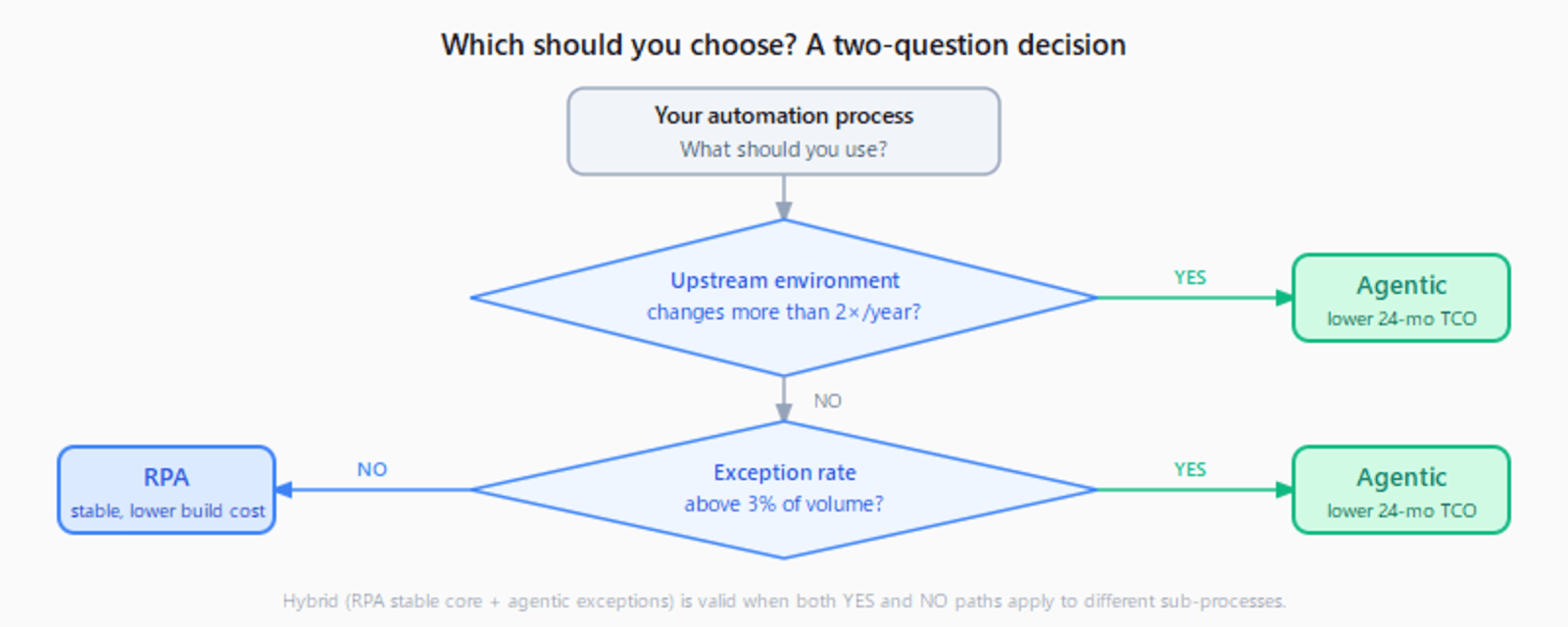
Two questions settle the decision for most processes:
- How often does the upstream environment change? If your ERP, vendor portal, or input document format changes more than twice a year, RPA maintenance will compound. Go agentic.
- What is your exception rate? Exception handling is the dominant TCO driver at scale. RPA's rule-based architecture makes high exception rates structurally expensive. If exceptions exceed 3% of volume, the agentic model reaches cost parity within 6-9 months and comes out lower by month 12-18.
For the narrow set of processes that are genuinely stable -- fixed schema, rarely-updated applications, deterministic outcomes -- RPA remains the cheaper option and is simpler to audit and govern. The hybrid strategy many enterprises land on reflects this: RPA for the stable core, agentic automation for the exception paths and high-variability inflows where the maintenance cliff otherwise eats the budget. A practical starting point: run your current RPA program's maintenance log for the last 12 months and total the hours spent on bot repairs and exception resolution. If that number exceeds 25% of your total automation labor, the process is a candidate for an agentic replacement. If it's below 10%, the existing RPA deployment is working as intended and the case for switching is weak.
FAQ
Is agentic AI cheaper than UiPath?
It depends on the process. For variable, exception-heavy workflows the 24-month TCO of an agentic system is typically 40-60% lower than UiPath once maintenance is included. For stable, rule-based processes, UiPath's fixed per-bot pricing can beat token-based agentic costs -- especially above 5,000 daily runs where token spend compounds without a corresponding maintenance reduction.
What does an AI agent cost per run?
Using a mid-tier frontier model at 3,000 tokens per run, cost ranges from $0.005-$0.02 per run depending on provider. With prompt caching for the system prompt, effective cost drops to $0.003-$0.010 per run for the cached prefix. Smaller open-source models self-hosted on commodity hardware can bring this below $0.001 per run for structured extraction tasks that do not require frontier reasoning.
How much does RPA maintenance really cost?
Published enterprise case studies consistently report 30-50% of total RPA program spend going to maintenance and troubleshooting -- primarily bot repairs triggered by upstream application changes. For a $5,000/month RPA deployment, that is $1,500-$2,500/month in ongoing labor, before factoring in downtime cost while bots are offline for repair.
When does agentic automation pay off vs RPA?
For processes with more than a 3% exception rate or upstream environment changes more than twice per year, agentic automation typically reaches cost parity with RPA within 6-9 months and comes out lower by month 12-18. For stable, low-exception processes, the payoff horizon extends to 24+ months and may never materialize if the process genuinely never changes.
What is the total cost of AI agents vs RPA at scale?
At 1,000 runs per day (30,000/month), the worked model above shows RPA at roughly $9,100/month versus agentic at roughly $4,000/month for a mid-complexity, variable process. At 10,000 runs/day, token costs close the licensing gap but maintenance and exception handling still favor agentic for variable workloads. RPA wins on total cost for high-volume, low-exception, stable-schema processes -- roughly 10,000+ daily runs at under 1% exception rate.